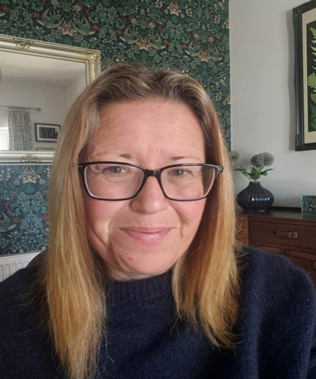
Ginny is an Advanced Clinical Practitioner working in a community Learning Disability service in Dorset.
What inspired you to become an advanced practitioner?
My desire to continually improve services for people with Learning Disabilities (LD) is what led me to Advanced practice, and to become part of the national network of ACP’s in a community learning disability service where Advanced practice is still in the minority. People with learning disabilities face too many disadvantages, significant health inequalities and die younger than their peers. As an advanced clinical practitioner, I can strive to improve this at service level.
Can you tell us about your journey towards becoming an advanced practitioner?
It started as a discussion in my appraisal that I was horrified by. The idea of University study in my 50’s was so terrifying. But over time I recognised that I have always continued to learn and develop, and I realised I did actually want to be an advanced practitioner. So off to University I went.
I started my journey towards advanced practice as part of a HEE funded pilot cohort on a virtual online PGCert in LD and autism that was aimed at those wanting to progress into Advanced Practice training. After completing the PGCert I undertook an accredited full AP MSc into which I was able to APEL 60 Level 7 Credits from my PGCert, again supported by HEE/NHSE funding. I chose to undertake an online AP MSc course and if I could give one piece of advice to future learners it’s don’t study entirely online. Face to face courses for this type of learning are needed – for support from both Uni and fellow students, and to learn effectively. I faced challenges and struggled in some parts so overall my journey to advanced practice was 5 years long, but I will say it was worth it.
How are you utilising the four pillars of advanced practice within your service?
| Clinical | – Senior clinical lead to multi-disciplinary LD team – Clinically accountable for team – Skilled in behaviour assessment and mental state examination- ensuring team are too – Evaluation of several pathways including end of life and bowel care recently- involved in all pathways – Risk management- setting up working group to look at needs of high-risk population – Physical examination of those who can’t access GP surgeries – Ensuring physical health compliance with NICE guidance re introducing anti psychotics in specialist services – Non-medical prescribing used to initiate medication and to decrease medication in line with STOMP – Empowering clinicians to complete physical health service development projects |
| Leadership | – Self-audit and team audit – Leadership to team of MDT staff – Coproduction – service users in interviews and accessible information group – Service development projects – Reviewing pathways – Recognising skills in teams to lead further change – Developing practice in leadership- leadership of new role re improving screening for people with disabilities – Consultancy to other services – Development of skills in other services- reducing restrictive practice group recently |
| Education | – Personal development plan in place and reviewed – Self-directed learning through literature and other teams – Contributes to the culture of organisational learning through finding the training to meet staff needs and reviewing its effectiveness – Team learning review through appraisals and team away days – Role mode educator- lone working/total communication/LD awareness – Coach and mentor to junior staff – Clinical supervision of others |
| Research | – Current service development project logged with QI team and audit team re bowel care – Previous action plan from QI project still being reviewed as needed – Audit of clinical practice- caseload review tool and team audit – Appraisal of recent research and sharing with team when proves to be quality research that can develop team- recent MSE guidance and research re healthy eating used to shape response in practice – QI poster and attendance at QI conference – Sharing best practice through ACP community of practices – Developing presentation for future ACP meeting re skills in LD service and adapted physical examinations – Empowering clinicians to take an active role in contributing towards and conducting LD research. |
What do you enjoy most about your role? What have you found most challenging?
The biggest challenge was achieving everything required of me academically throughout the course, but I was so well supported by my line manager, the LD team and by the wider organisation. I have always loved working with people with learning disabilities and was a senior clinical lead before I commenced advanced clinical practice. The challenge of this role was to ensure I could meet clinical demand and put my newly developed skills into practice, while fulfilling the remaining management aspects of the role. I was fortunate that as a service we could reconfigure roles and recruit an operational lead so we can support each other. Our team is excellent, and everyone works together to improve the lives of people with learning disabilities. I am so proud of the work we do and my aim is to share this work widely.
What advice would you to give to an individual considering an advanced practice roles?
Firstly, I would say that I would like to see every community LD service have advanced practitioner/s. The work that we do is specialised and already requires us to be multi-skilled. Advanced practice clearly defines work that is already being completed and encourages us to share widely.
For prospective advanced practice students; I know how easy it is to discount the need for the highly skilled physical health competencies. I railed against this at first and felt that advanced practice in LD services was far more about service development than providing medical level physical healthcare. I couldn’t see the value of being skilled at cardiac examination when I spend my days completing mental state examinations and behaviour formulation. I was worried that developing skills in this area would diminish the need for primary and secondary healthcare to make necessary reasonable adjustments. Gaining skills in areas I’d never used before was a struggle but was possible through having the most excellent clinical educator – so do make sure you get this support too.
On qualifying, it all clicked into place, and it became clear that having this level of physical health skills in mental health settings and LD services is invaluable. It is not about replacing primary healthcare, but about improving opportunities for physical health checks to be completed, especially for those who fear or avoid the GP. I have had so many wonderful experiences of being able to use physical health examination skills to add to my assessment and care plans: to manage constipation successfully, to monitor side effects of medication, and to aid in the diagnosis of physical health complaints that may well have added to the persons low mental health or behavioural episodes.
All the ACP pillars are equally important, yet we do find that many ACP job plans prioritise clinical work at the detriment of leadership or research. I would encourage everyone to ensure you balance your job plan and review it regularly.
Read more advanced practice case studies from the South West region here