What to expect through your advanced practice journey
Updated: March 2026
Produced by
Kim Treverton, Primary Care Advanced Practice Training Programme Lead, NHS England, East of England
Contributors
Produced in collaboration with East of England regional higher education institutes (HEIs), colleagues from NHS England Workforce, Training, and Education Directorate, ICS Advanced Practice Leads, and Advanced Practice Leads and Supervision Ambassadors from primary care training hubs.
Invaluable input provided by:
Katie Cooper, National Head of Multi-professional Advanced Practice, NHS England, East of England
Dr. Gabrielle Thorpe, Head of Department: Post-Qualifying Programmes, School of Health Sciences, University of East Anglia
Vikki-Jo Scott, Advanced Practice Programme Lead, School of Health and Social Care, University of Essex
Lorna O’Reilly, Deputy Head of School for Advanced Practice and Programme Lead for MSc Advanced Practice, Anglia Ruskin University
Contents
- Introduction
- Aspiring advanced practitioners
- Trainee advanced practitioners
- Applying for a trainee advanced practitioner post
- Considerations when starting an advanced practice MSc programme
- Programme and module requirements
- Supervision
- Managing work-life-study balance
- References
- Useful websites
Download PDF version of this document by visiting the NHS Learning Hub
Introduction
The purpose of this document is to provide a resource and reference for those considering applying to an Advanced Practice MSc programme or those who have been accepted into a Trainee Advanced Practice role and are preparing to start their advanced practice journey.
This document has been created by the NHS England East of England Faculty for Advancing Practice, with input from colleagues from other regional faculties, advanced practice leads, regional HEIs, and qualified advanced practitioners with recent experience of advanced practitioner training and education.
Advanced practice is an area of healthcare that is evolving at pace. This document provides guidance for registered health professionals considering the next step in their career and aims to be informative and supportive in this challenging and rewarding role.
Aspiring advanced practitioners
Is advanced practice for me?
If you are an aspiring advanced practitioner, it is important to understand the expectations and commitment required to develop and meet the minimum requirements expected of this role. Health and care professionals working at an advanced level of practice must demonstrate the underpinning competencies, skills, and behaviours applicable to the workplace setting (specialist or generalist) and within the defined role within which they are working.
The Multi-professional framework for advanced clinical practice in England published by NHSE in 2025 stipulates 38 core capabilities extending across the four pillars of advanced practice: expert clinical practice, leadership and management, education, and research, that advanced practitioners are required to evidence. A master’s-level educational qualification is required to ensure those working at the level of advanced practice have been trained and educated to achieve and demonstrate these capabilities.
Take time to reflect on your clinical interests, career aspirations, and potential career trajectories and consider if becoming an advanced practitioner might be right for you.
Read and understand the national curricula and capability frameworks relevant to the area or field in which you would like to practice as an advanced practitioner.
Think about or write down experiences, expertise, and education you have that would support an advanced practice pathway. Identify the stepping-stones that will strengthen your case and identify any gaps where further support is required.
Initiate a career conversation with your line manager and organisational advanced practice lead; for Primary Care, contact your local training hub. Visit The Centre for Advancing Practice website and the East of England regional faculty webpage for further information about advanced practice.
Trainee advanced practitioners
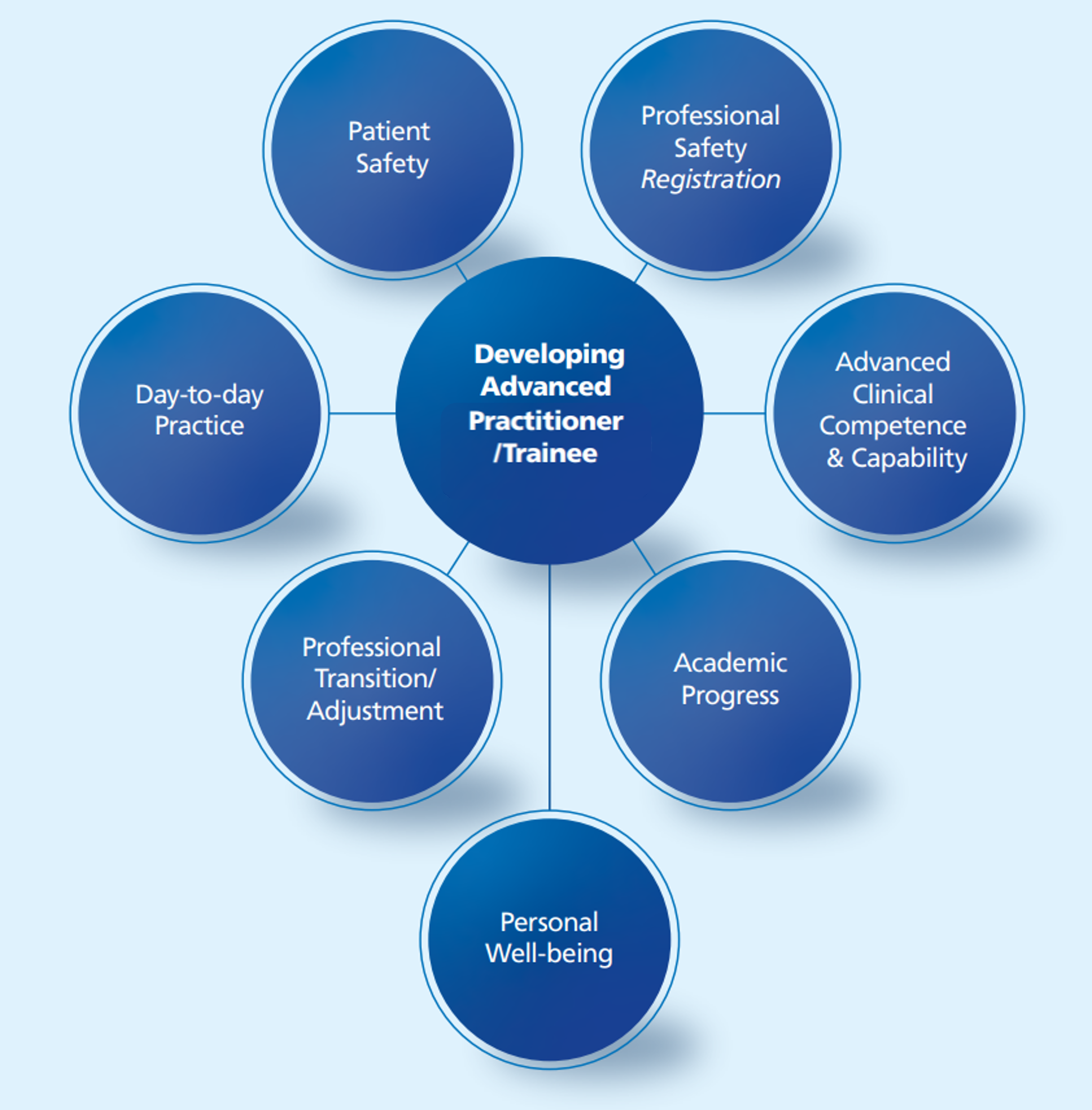
A trainee advanced practitioner is an experienced healthcare professional employed in a funded training post that will enable the development of required underpinning knowledge, skills, and insight to work safely at the level of advanced practice. Advanced practice embodies the ability to holistically manage episodes of clinical care in partnership with the multi-professional team, ensuring the voice of the service users, families, and carers are at the centre of the provision of care. It includes the analysis of complex issues across a range of health and care settings, synthesising information from diverse sources of evidence to identify and implement innovative solutions to improve patient experience and health outcomes. (Figure 1)
Figure 1
Applying for a trainee advanced practitioner post
Essential requirements
- Current professional healthcare registration
- An identified and agreed advanced practice role which is guaranteed post-qualification
- Extensive experience post registration in the relevant specialty area (recommend a minimum of 3 years clinical experience post registration with a further 2 years within the specialty area).
- Ability to study at master’s level (level 7). Any practitioner who does not clearly meet the academic criteria to study at level 7 may need to consult with the respective HEI to establish any additional educational requirements prior to commencing an advanced practice master’s programme.
- If considering an Advanced Practice Degree Apprenticeship** route, level 2 (GCSE or equivalent) English and maths are no longer a mandatory requirement, however, the HEI may continue to require it as entry criteria. Working no less than 30 hours per week is also essential. More information on the requirements of the Advanced Practice Degree Apprenticeship can be found here.
Academic and professional eligibility
Trainees, as well as line managers and employers should ensure HEI entry criteria for the proposed advanced practice programme are met before applying for a place. This may vary slightly between HEIs but as a guide includes evidence of at least a level 6 (degree-level or higher) qualification. Depending on the HEI, this may be a full degree or a set number of level 6 academic credits. The level achieved is normally expected to be at least 2:2 and may be 2:1 for some HEIs. Please check directly with the HEI if you have overseas qualifications. Protected study time to complete the educational requirements of the programme is essential. This will vary between HEIs and modules undertaken and is likely to include in-person and live online attendance, as well as the completion of asynchronous directed and independent study and assessment activities. Some modules will also require formal assessment in practice with oversight from a suitably qualified and experienced practitioner.
The trainee must have current registration with one of the statutory regulators of health and care professions.
** From 1 January 2026, Level 7 apprenticeships will only be government-funded for apprentices who, at the start of their apprenticeship training, are either aged 16-21, or aged under 25 and have an Education, Health and Care (EHC) plan and/or have been, or are, in the care of their local authority. Any individual who started a level 7 apprenticeship before 1 January 2026 will continue to be funded through to completion. For Advanced Practice Degree Apprenticeship Programmes, there is mitigation funding in place. Please contact your organisational Advanced Practice lead for further information.
Trainee advanced practice post: interview and selection process for trainee advanced practice role
As part of the recruitment and selection process for a trainee advanced practice post, aspiring trainees should be prepared to undertake the following in relation to the interview and selection process. This process may not be applicable to some healthcare settings:
If shortlisted for interview, a trainee can expect an interview panel to have, as a minimum, a senior clinician, organisational advanced practice lead or equivalent, and managerial representation. HEI advanced practice programme leads may be included in the recruitment process as well.
Following selection, candidates may ask for feedback relating to their profile and/or performance at interview from those involved in the interview process. Fair recruitment processes will be followed. NHSE-East of England, No More Tick Boxes (2021), section 3- ‘Putting a different approach into practice’ can be reviewed.
Successful applicants considered to have relevant prior experience, will have their evidence mapped to the relevant curricula/capabilities identifying gaps where additional training is required along with appropriate banding level (if applicable). Usual recruitment processes will follow.
Considerations for commencing an MSc Advanced Practice programme
Understanding of and preparation for advanced practice
It is important for trainee advanced practitioners to understand the following documents and processes, which provide essential context for advanced practice in England:
Multi-professional framework for advanced clinical practice in England (2025)- This document draws on and consolidates existing frameworks relating to advanced clinical practice from across the UK and provides guidance and principles for current and future professionals working at the level of advanced practice.
Programme accreditation-The Centre’s programme accreditation provides assurance to the wider system of the quality of advanced practice education programmes. Accredited programmes map to the 38 capabilities across the four pillars of the Multi-professional framework for advanced clinical practice in England (2025) and Standards for Education and Training (SET) (HEE, 2020).
Advanced Practice Programme Accreditation-To find out which programmes have been accredited by NHSE please visit: Programme Accreditation Resources.
Capability frameworks (some profession specific examples)
- Primary Care and General Practice Nursing Career & Core Capabilities Framework
- Paramedic Specialist in Primary and Urgent Care Core Capabilities Framework
- Musculoskeletal Core Capabilities Framework for First Point of Contact Practitioners
- The Ophthalmic Common Clinical Competency Framework – Curriculum (OCCCF)
- Royal Pharmaceutical Society
Preparation for level 7 study
Level 7 study, or master’s level study, is characterised by an expectation of students’ expertise in their specialism. Learners are semi-autonomous, demonstrating independence in the negotiation of assessment tasks and the ability to evaluate, challenge, modify, and develop theory and practice. Learners are expected to demonstrate an ability to isolate and focus on noteworthy features of problems and to offer synthesized and coherent solutions, with some students producing original or innovative work in their specialism that is worthy of publication or display.
QAA Qualifications Frameworks-This framework lists descriptors for higher education qualifications at various levels in the UK, including level 7.
Programme and module requirements
Timetables and study
Time required for study will vary according to the training route and the specific HEI module and programme requirements. However, all trainees will require protected study leave to attend face to face or live online sessions, undertake associated background reading and written coursework, and plan and complete academic and/or work-based assessments.
Trainees may also require time for additional academic or well-being support to optimise success in their studies. This is crucial to ensure patient and professional safety and that the fundamentals of advanced practice are addressed and trainees are given opportunities to discuss matters arising.
Trainees will be expected to dedicate a significant amount of time to independent study. The notional number of hours of study and teaching expected is approximately 100 hours per 10 academic credits (this includes both taught hours, work-based learning, and independent study hours). However, the actual time spent may be more or less, dependent on individual learners and should be discussed and negotiated with the trainee’s coordinating education supervisor.
Trainees are expected to discuss study requirements with the relevant HEI and ensure that adequate study time is allocated and agreed with line managers prior to applying for the course.
For trainees on the Advanced Practice Degree Apprenticeship programme, the trainee must spend at least 20% of their normal working hours, over the planned duration of the apprenticeship practical period, on “off the job” training.” Apprentices must be employed for a minimum of 30 hours. The minimum requirement for apprentices working 30 hours or more per week is an average of 6 hours of off-the-job training per week (i.e. 20% of 30 hours) over the planned duration. The apprentice is responsible for monitoring and recording this time in line with GOV.UK apprenticeship funding rules.
For trainees on a direct entry (non-apprenticeship) Advanced Practice MSc programme, employers are expected to provide the trainee with sufficient protected study leave and adequate time for work-based learning per week, and it is recommended that this is in line with the requirements of the apprenticeship programme, as stated above. The HEI programme leads will provide information on the total amount of study days/hours required for the module on which the trainee is enrolled, as this may vary between modules depending on the nature of the learning and assessment required. For trainees who are already part way through their programme and are funded for either one or two years, the time required for study leave will vary according to individual needs. Trainees may benefit from rotations or placements in other areas within the organisation to gain the required breadth of experience.
Individual module requirements
Course module information can be found on individual HEI websites. Any questions about HEI course content, application processes, or individual modules should be referred directly to the HEI and the course lead. Links to the East of England HEIs and advanced practice programmes can be found in NHS England East of England advancing practice stakeholder guidance document.
All HEI programmes will be taught by lecturers and expert clinical practitioners in their field who will offer dedicated academic support and guidance. Trainees will be allocated a named personal advisor.
Formative and summative assessment strategies across programme include written assignments, unseen examinations, case study analysis and evaluation, objective structured clinical examinations (OSCEs), group/individual poster/oral presentations, practice assessment documents, and portfolios.
It is recommended that the HEI meets with the trainee and coordinating education supervisor at specified times during the programme of study to plan individual educational needs and monitor progress; also referred to as ‘tripartite’ meetings
Supervision
High quality supervision for healthcare professionals moving into trainee advanced practice roles is essential for supporting the development of confidence and capability and underpins patient and practitioner safety. The Centre for Advancing Practice has several resources to support supervision and assessment.
It is essential for trainees to have supervision accommodation agreed with their organisation or line manager prior to commencing an advanced practice programme.
NHS England has developed the following supporting documents that should be reviewed by all trainees as well as employers who already have or are looking at developing advanced practice roles.
Workplace Supervision for Advanced Clinical Practice document provides in-depth, evidence-based information and recommendations on how to develop quality supervision in the workplace.
Advanced Practice Workplace Supervision Minimum Standards for Supervision provides guidance for supervisors, managers, employers, and trainee advanced practitioners about NHSE Centre for Advancing Practice minimum expected standards for supervision.
The Centre for Advancing Practice has created some short video resources to accompany the ‘Workplace Supervision for Advanced Clinical Practice: An integrated multi-professional approach for practitioner development’ guidance (NHSE, 2025). The videos provide practice insights for each of the fundamentals of supervision set out in the guidance and are a useful resource for anyone who is developing or providing supervision for trainee advanced practitioners. Requirements for supervisors are explained in more detail on the Supervision and Assessment resources webpage on the Centre for Advancing Practice website.
Managing work-life-study balance
Recognising extenuating or changing circumstances and managing the impact on study
From time to time, a trainee may experience unexpected personal or work-related circumstances beyond their control that impact on their ability to study. These are referred to as ‘extenuating circumstances.’ The sooner the coordinating educational supervisor, organisational advanced practice lead, and HEI advisors are made aware, the sooner the appropriate reasonable adjustments can be put in place and appropriate levels of support provided. A trainee may require the support of additional services within the HEI or require an extension for an assignment.
Occasionally, some trainees may need to suspend their studies to resolve the situation or make longer term arrangements. This is called ‘intercalation’ or ‘intermission’ by the HEI or simply a pause in training. If the course costs are covered by NHS England, funding is suspended and may be resumed when the trainee returns to study. However, situations are reviewed on a case-by case basis as it is dependent on whether the trainee can complete the course within the timescales available on their return. In the first instance, the trainee should have a conversation with their coordinating educational supervisor and advanced practice lead/training hub.
For information about changes to circumstances and programme funding, please see NHSE EoE advancing practice stakeholder guidance
In all circumstances, NHS England should be informed immediately by completing and sending a Notification of Change Form to the East of England Faculty for Advancing Practice at england.eoeapfaculty@nhs.net
Support for trainees or trainees in difficulty
General principles

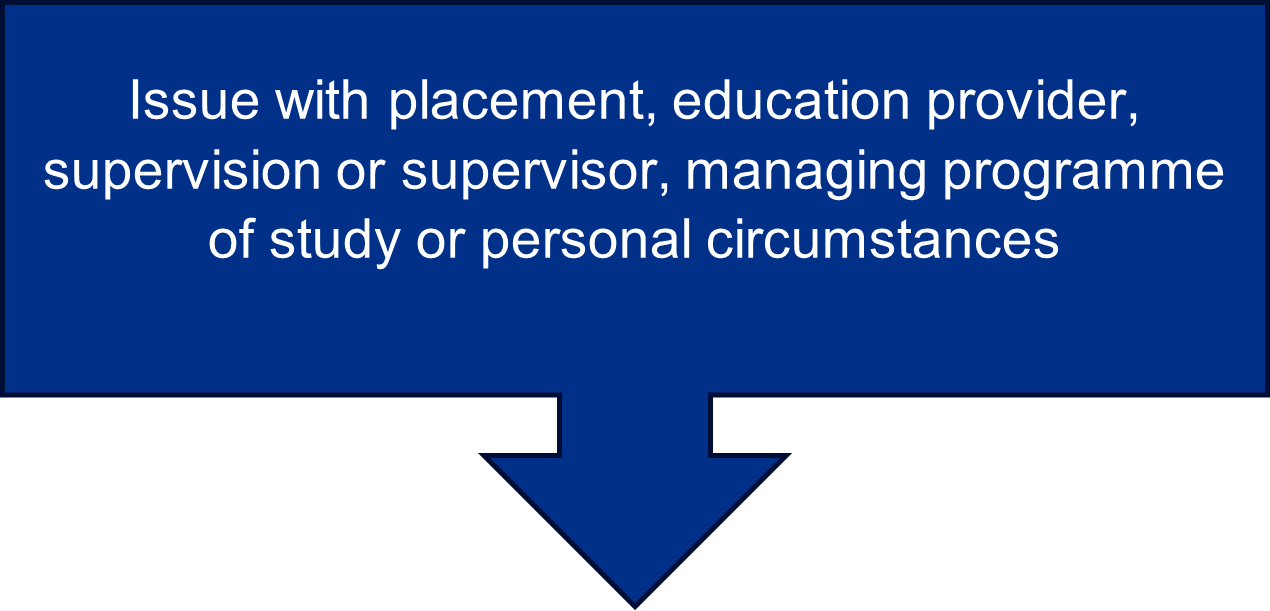




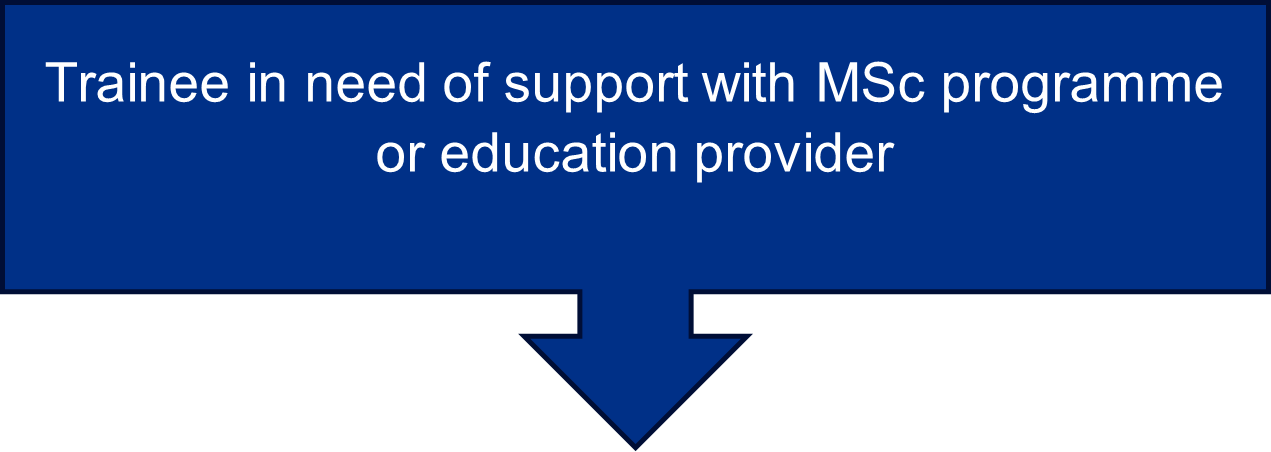
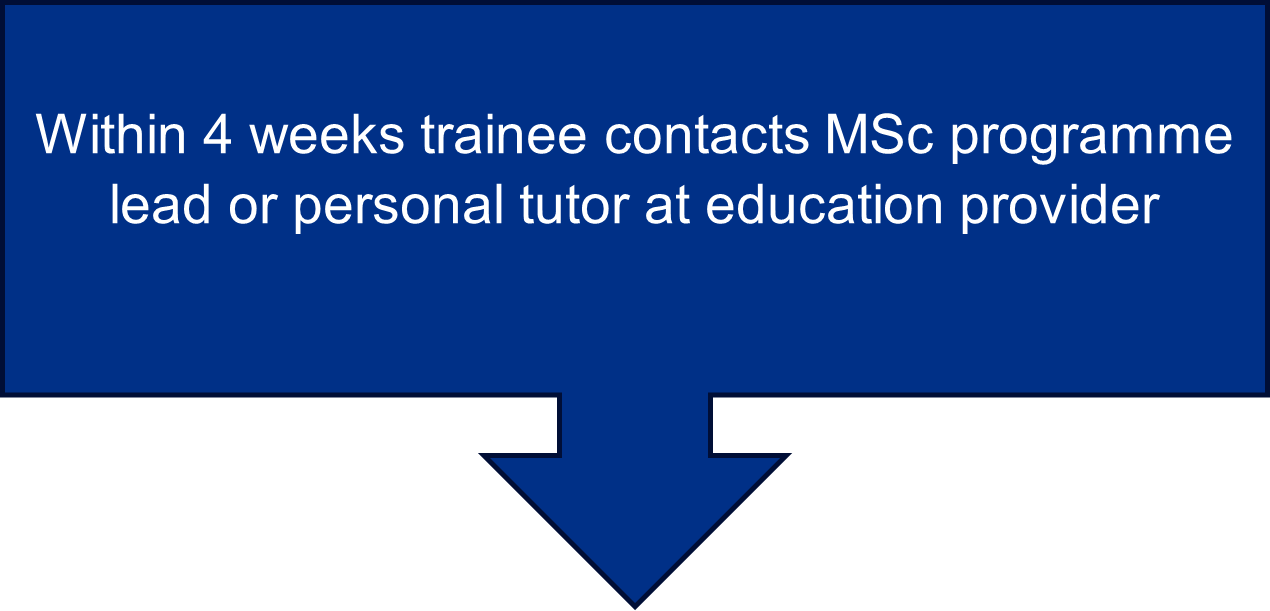
Trainees requiring support with education provider
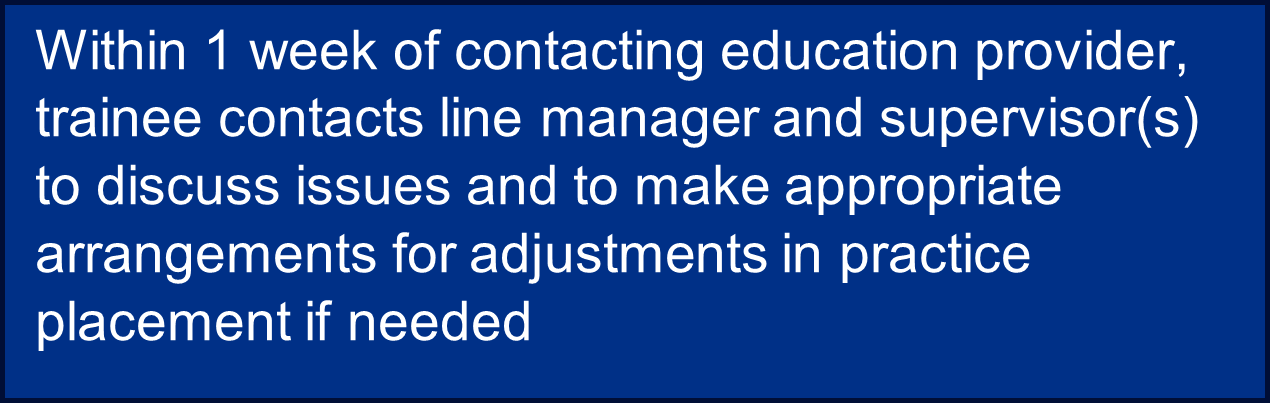
There is an expectation for all advanced practice trainees to be proactive in managing their learning journey. This includes acting to manage and resolve problems that may occur during their training programme, with the support of their manager, supervisor, organisational/training hub advanced practice lead, MSc programme lead, and the NHS England – East of England Faculty for Advancing Practice.
Trainees requiring support in placement areas
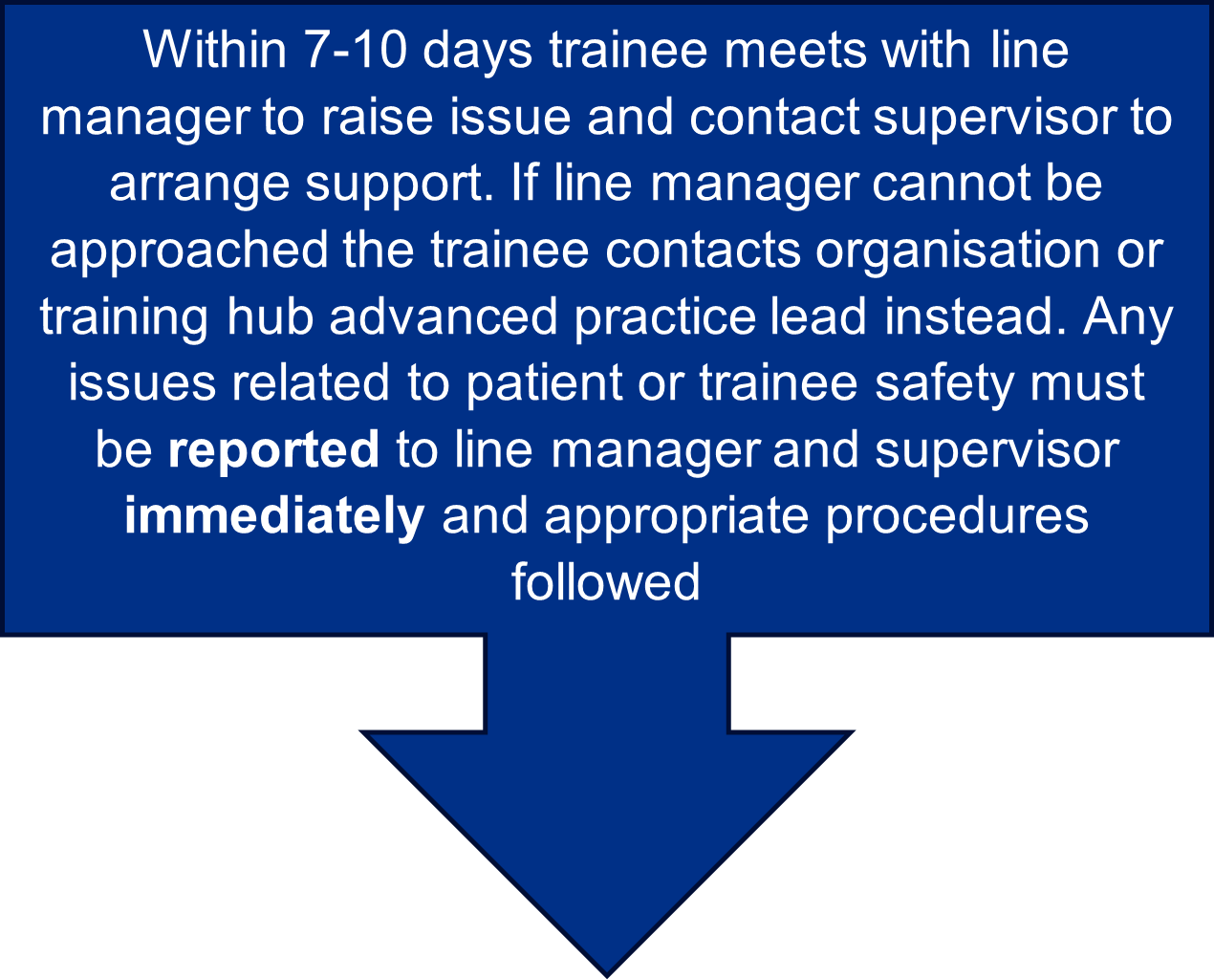
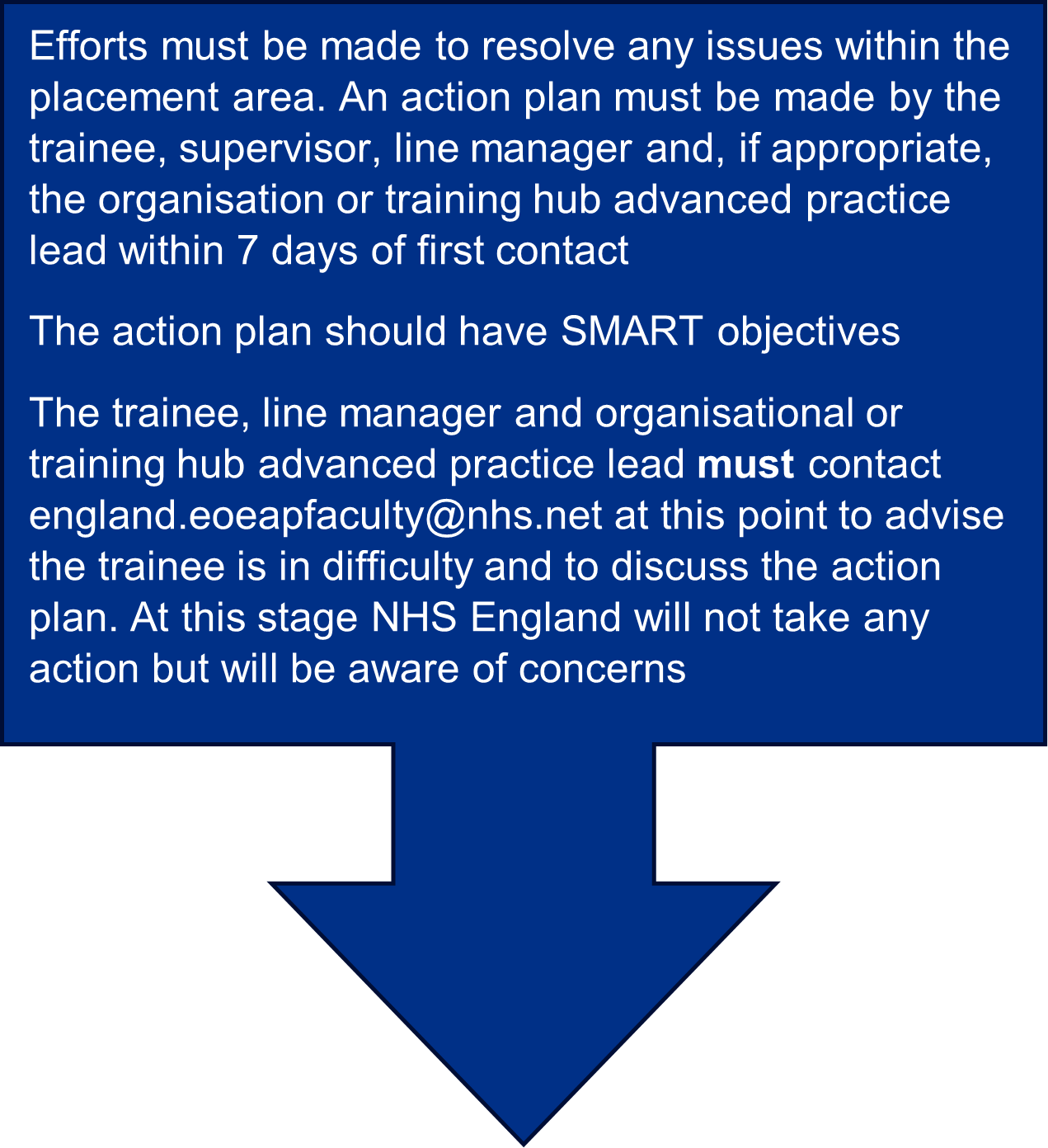
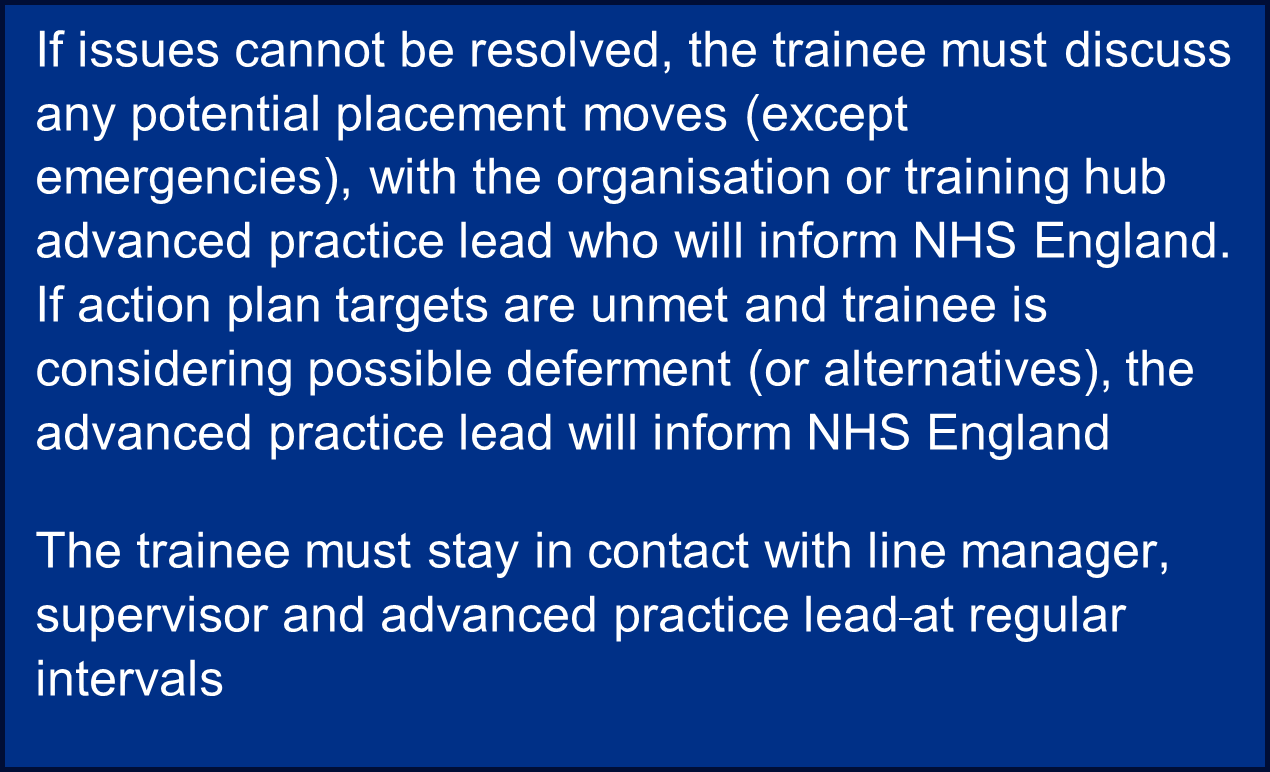
There is an expectation for all advanced practice trainees to be proactive in managing their learning journey. This includes acting to manage and resolve problems that may occur during training, with the support of their line manager, supervisor, organisational advanced practice lead, MSc programme lead, and the NHS England – East of England Faculty for Advancing Practice.


Trainees with physical or mental health conditions or specific learning differences (SpLDs)
The HEI will have a dedicated counselling/ wellbeing service as well as a disability support service. It is important to share any known or suspected disability at application, to ensure that any support needs or other necessary arrangements can be discussed and organised in advance. Help will be offered when applying for Disabled Students’ Allowance. For trainees who disclose a disability, assessment adjustments can be made, as well as help provided with assistive equipment and technologies.
If English is not a first language or if this is the first time studying in the UK, please contact an advisor to discuss personal learning needs. All HEIs have English language and academic support available for learners who may require some guidance to help start studying with confidence.
Other resources:
Reasonable adjustments for workers with disabilities or health conditions
Reasonable adjustments for people with a learning disability
NHS England health and wellbeing support
References
Anglia Ruskin University (2024) Generic assessment criteria and marking standards. Available online at: https://library.aru.ac.uk/module_guide/modguide_level7_asst_crit.pdf
Department for Education (2023) Apprenticeship funding rules. GOV.UK. Available online at: https://www.gov.uk/guidance/apprenticeship-funding-rules-for-employers
Department of Works and Pension (2023) Student Adjustments Planner. GOV.UK Available online at: https://www.gov.uk/government/publications/student-adjustments-planner
Education & Skills Funding Agency (2023) Adult education budget: funding and performance management rules 2023 to 2024. GOV.UK. Available online at: https://www.gov.uk/government/publications/adult-education-budget-aeb-funding-rules-2023-to-2024/esfa-funded-adult-education-budget-funding-rules-2023-to-2024
Equality Act 2010. Available online at: https://www.legislation.gov.uk/ukpga/2010/15/contents
GOV.UK (2024) Reasonable adjustments for workers with disabilities or health conditions. Available online at: https://www.gov.uk/reasonable-adjustments-for-disabled-workers
Health Education England and NHS England (2018) Musculoskeletal core capabilities framework for first point of contact practitioners. NHS. Available at: https://www.csp.org.uk/system/files/musculoskeletal_framework2.pdf
Health Education England (2021) Primary Care and General Practice Nursing Career and Core Capabilities Framework. NHS. Available at: https://www.skillsforhealth.org.uk/app/uploads/2022/05/Primary-Care-and-GPN-Framework-May22.pdf
Health Education England (2020) Standards of Education and Training (SET) for Advanced Practice Programmes leading to programme recognition with The Centre for Advancing Practice. NHS. Available online at: https://www.hee.nhs.uk/sites/default/files/documents/June%202020%20SET%20Existing%20programmes%20%282%29.pdf
NHS (2023) NHS equality, diversity, and inclusion improvement plan. Available online at: https://www.england.nhs.uk/publication/nhs-edi-improvement-plan/
NHS (2020) We are the NHS, People Plan 2020/21-action for us all. Available online at: https://www.england.nhs.uk/ournhspeople/
NHS England (2023) Advanced Practice Supervisor Capabilities. NHS. Available online at: https://advanced-practice.hee.nhs.uk/advanced-practice-supervisor-capabilities/
NHS England (2025) Advanced practice workplace supervision: Minimum standards for supervision. NHS. Available online at: https://advanced-practice.hee.nhs.uk/resources/supervision-and-assessment-resources/
NHS England (2025) Employer’s advanced practice supervision action plan. NHS. Available online at: https://advanced-practice.hee.nhs.uk/resources/supervision-and-assessment-resources/
NHS England (2025) Multiprofessional framework for advanced practice in England. NHS. Available online at: https://advanced-practice.hee.nhs.uk/
NHS England (2025) NHSE EoE advancing practice stakeholder guidance document 2025/26. NHS. Available online at: https://advanced-practice.hee.nhs.uk/regional-faculties-for-advancing-practice/regional-faculty-for-advancing-practice-east-of-england-2/east-of-england-advancing-practice-stakeholder-guidance/
NHS England (2021) No More Tick Boxes. NHS. Available online at: https://www.england.nhs.uk/east-of-england/wp-content/uploads/sites/47/2021/10/NHSE-Recruitment-Research-Document-FINAL-2.2.pdf
NHS England (2025) Readiness to become an advanced practitioner. NHS. Available online at: https://advanced-practice.hee.nhs.uk/resources/supervision-and-assessment-resources/
NHS England (2025) Supervisor readiness checklist Health Education England. NHS. Available online at: https://advanced-practice.hee.nhs.uk/resources/supervision-and-assessment-resources/
NHS England (2025) Workplace Supervision for Advanced Practice. NHS. Available online at: https://advanced-practice.hee.nhs.uk/our-work/supervision/
NHS England (2025) Workplace Supervision for Advanced Clinical Practice-supporting videos. NHS. Video resource available online at: https://advanced-practice.hee.nhs.uk/our-work/supervision/supervision-and-assessment-resources/
QAA (2024) The Frameworks for HE Qualifications of UK Degree-Awarding Bodies. Available online at: https://www.qaa.ac.uk/the-quality-code/qualifications-frameworks#
Public Health England (2020) Reasonable adjustments for people with learning disability. GOV.UK. Available online at: https://www.gov.uk/government/collections/reasonable-adjustments-for-people-with-a-learning-disability
Royal Pharmaceutical Society (2013) The RPS Advanced Pharmacy Framework. RPS. Available online at https://www.rpharms.com/resources/frameworks/advanced-pharmacy-framework-apf:
The Royal College of Ophthalmologists and Health Education England (2019) RCOPHTH. The Ophthalmic Common Clinical Competency Framework. Available at: https://www.rcophth.ac.uk/training/ophthalmic-practioner-training/
Useful websites
https://advanced-practice.hee.nhs.uk/
https://advanced-practice.hee.nhs.uk/resources/programme-accreditation-resources
https://www.apprenticeships.gov.uk
https://educationhub.blog.gov.uk/2023/06/09/how-supporting-university-students-mental-health
https://www.england.nhs.uk/long-read/nhs-equality-diversity-and-inclusion-improvement-plan
https://www.england.nhs.uk/supporting-our-nhs-people/health-and-wellbeing-programmes
https://www.gov.uk/disabled-students-allowance-dsa
https://www.gov.uk/what-different-qualification-levels-mean/list-of-qualification-levels
https://www.hee.nhs.uk/our-work/training-hubs
https://www.nhsemployers.org/articles/advanced-practice-and-enhanced-practice