Minimum Standards of Governance for the multi-professional advanced and consultant level practice workforce.
This document has been developed through co‑production and has been approved through the required governance processes. It is now pending formal publication.
1. Introduction
Robust, credible organisational governance is central to the safe, effective and successful employment and deployment of the multi-professional advanced and consultant practitioner workforce.
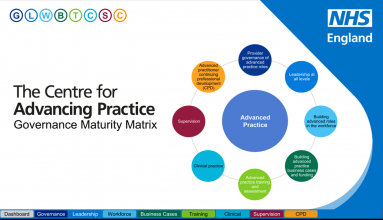
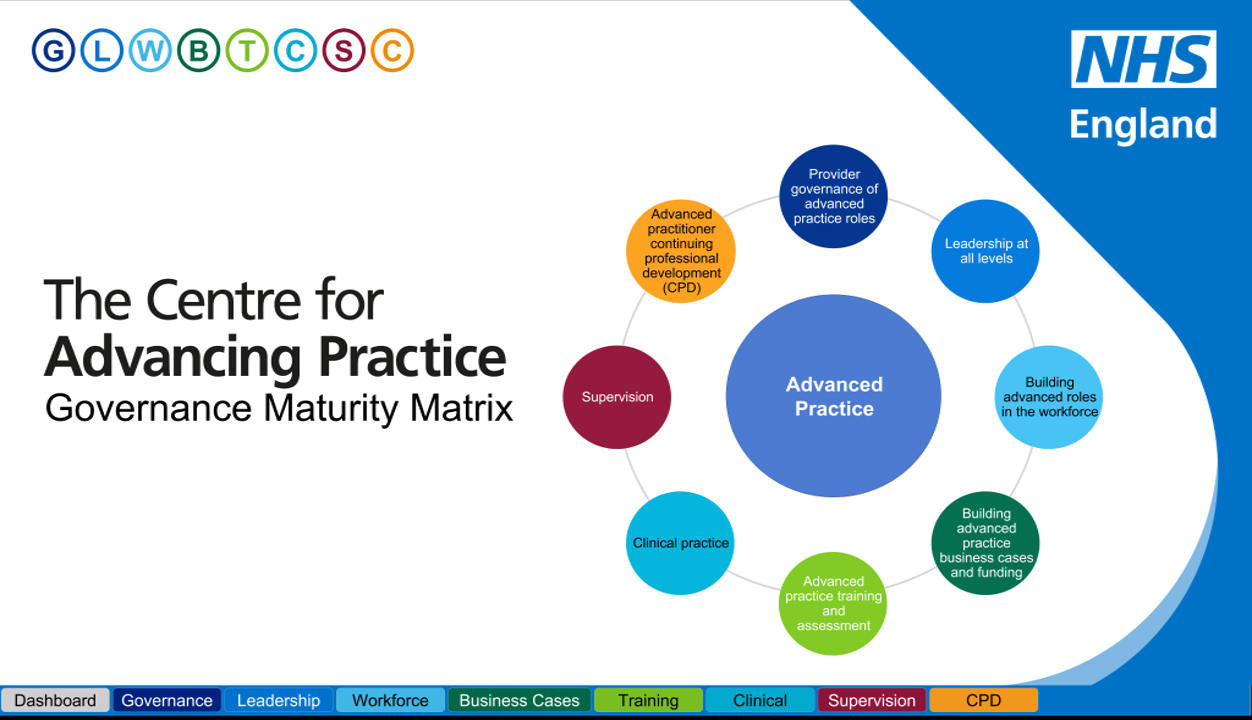
In 2023, we published the ‘Governance maturity matrix’ (‘the maturity matrix’) to help organisations assess and improve advanced practice standards.
Since the publication of the maturity matrix, organisations have had the opportunity to use it to drive development and improvement in their approaches to governing advanced practice. Many organisations have already put in place sufficiently robust arrangements for the governance of their trainee and advanced and consultant practice workforce. However, we know that not all have. We now need to raise standards across the sector by setting out the minimum standards for governance, including scope of practice, that we consider are necessary for each and every organisation to meet.
Creating well-governed, positive environments for healthcare colleagues to develop advanced and consultant level practice can contribute to open, positive and inclusive teams and improved organisational culture, key in supporting stable recruitment, retention and safe patient care.
‘Organisation’ in this standard refers to any organisation involved in the employment and/or deployment of the advanced and consultant practice workforce. This includes, for example, organisations in acute care, primary care, community care and mental health. As well as private, voluntary and independent sectors, and practitioners working at an advanced and consultant level of practice via locum contracts that provide NHS services.
It is recommended that the following frameworks are accessed and read in conjunction with these standards:


Further resources related to supervision, governance and workforce planning can be found in the Centre for Advancing Practice resource area .
2. About the minimum standards for governance
The minimum standards set out threshold-level requirements for organisations for the governance of the multi-professional advanced and consultant practice workforce.
The overall purpose of setting out minimum standards is to help ensure the following outcomes:
- Advanced and consultant practitioners are supported through systems of infrastructure to provide high quality, safe, inclusive health and care which meets the needs of patients, their families and carers.
- The learning environment for trainee and qualified advanced and consultant practitioners is safe, supportive, effective and linked to the
- there are inclusive, fair and equitable opportunities for practitioners from statutory regulated professions to develop into advanced and consultant practice roles
- services and systems fully utilise the advanced and consultant practice workforce to meet population health and service needs
- investment in the advanced and consultant practice workforce delivers value for money and achieves return on investment, optimises care and supports pathway transformation
- support understanding of organisational and practitioner liability
- support organisations in meeting their responsibilities in relation to The Health and Social Care Act 2008 (Regulated Activities) Regulations 2014, particularly in relation to:
- Regulation 12(1) and 12(2)(c)
- “Care and treatment must be provided in a safe way for service users … ensuring that persons providing care or treatment to service users have the qualifications, competence, skills and experience to do so safely”
- Regulation 18 (2) (a)
- “Persons employed by the service provider in the provision of a regulated activity must … receive such appropriate support, training, professional development, supervision and appraisal as is necessary to enable them to carry out the duties they are employed to perform”
- Support organisations in providing evidence for quality inspections such as Care Quality Commission (CQC). CQC assesses clinical competencies primarily through Regulation 18(2)(a): Staffing
The minimum standards set out a threshold benchmark for ensuring quality in education and safety in service delivery. Organisations should be able to demonstrate how they are working towards, meet, or exceed the minimum standards ensuring that robust governance and assurance processes are in place.
The minimum standards do not replace the maturity matrix which can still be used by organisations to self-assess their progress and to support continued development in this area.

3. Professional regulation and organisational governance
Advanced and consultant practice is delivered by health and care professionals who are registered by a statutory regulatory body, and whose education and training at either level is underpinned by a post-registration master’s level award or equivalent. Each regulator publishes standards which its registrants, including those practising at advanced and consultant level, are required to meet.
The Nursing and Midwifery Council (NMC) plan to put in place additional regulation of advanced practice nurses and midwives and have published a set of Principles for advanced practice. Other regulators have stated that existing arrangements for registration are sufficient to manage any risks arising from advanced practice without any need for additional regulation.
The Health and Care Professions Council (HCPC) have an annotation on the register for podiatric surgery. The annotation indicates that a registered podiatrist has undertaken additional HCPC approved training, meets specific standards of podiatric surgery, and is committed to ongoing professional development to ensure public safety.
Organisations will need to ensure that the advanced and consultant practitioners they employ, including via locum contracts, meet the requirements of their professional regulators, which may change over time.
Professional regulation has an important role to play but does not replace the crucial role of robust organisational governance of the advanced and consultant practice workforce in providing high quality, safe care for patients, their families and carers.
4. Minimum standards
The minimum standards for the governance of the advanced and consultant practice workforce are set out below.
Governance
- there must be a named person(s) with lead responsibility for the advanced and consultant practice workforce, that reports directly into the senior structure, for example, board level within an acute or community trust or primary care network
- the named person(s) with lead responsibility for the advanced and consultant practice workforce should:
- be either an advanced or consultant practitioner
- have appropriate skills and experience, including an in-depth understanding of advanced and consultant level practice and governance implementation
- have a job description and allocated time for their leadership role within their job plans, enabling effective partnership working with multi-professional clinical leads or executive leadership of the organisation and external stakeholders
If the named person with lead responsibility for the advanced and consultant practice workforce is not an advanced or consultant level practitioner, they must be a statutory registered health care professional and:
-
- have appropriate skills and experience including an in-depth understanding of advanced and consultant level practice and governance implementation
- have access to advice and support from (an) advanced or consultant level practitioner(s) from multi-disciplinary backgrounds, which may be from an external organisation
- have a job description allocated time for their leadership role within their job plan, enabling effective partnership working with multi-professional clinical leads or executive leadership of the organisation and external stakeholders
- the organisation must have a clear overview of all individuals working in the advanced and consultant practice workforce – this includes:
- up-to-date and accurate staff records, (such as the Electronic Staff Record or the National Workforce Reporting System)
- ability to evidence practitioners’ education, training, competencies and capabilities that underpin their level of practice
- recognition of holders of NHS England’s ‘Advanced’ digital badge
- there must be clear and consistent reporting and accountability lines, which includes professional leads for those working at an advanced and consultant level
Leadership
- there must be clear leadership structures in place for all advanced and consultant practitioners / teams at all relevant organisational levels.
- the organisation must be aware of wider NHS lines of accountability and respond to reporting requests, ensuring advanced and consultant roles are discussed and included in workforce and educational planning submissions.
Workforce
- there must be job description templates and agreed terminology for the trainee advanced practitioner and the advanced and consultant practitioner workforce across the pillars of professional practice
- advanced and consultant practice must be integrated into organisational workforce planning at all levels, with clarity about the roles within team structures
- organisations should ensure that advanced and consultant practitioners are clearly identifiable to the multi-disciplinary team and patients. Therefore, it is recommended that job role titles should normally integrate clear identification of a practitioner’s level of practice at either advanced or consultant level, registered profession, and the option to include their speciality of practice. Examples of different advanced practice job role titles in this format are ‘Advanced Nurse Practitioner (Acute Medicine)’ and ‘Advanced Paramedic (Urgent Care)’. Examples of consultant practice job role titles in this format are ‘Consultant Physiotherapist (Frailty) and ‘Consultant Pharmacist (Oncology). Existing roles currently titled ‘advanced’ or ‘consultant’ with no identification of profession or optional inclusion of speciality, should be reviewed, but the decision whether to align existing role titles with these recommendations rests with individual employers
- there must be inclusive recruitment processes for practitioners that prevent underrepresented groups from being disadvantaged and recruitment processes should be fair, equitable and free from bias
- the organisation must have consistent standards for job plans, appraisals and scope of practice documents which are representative of clinical responsibility and inclusive of the pillars of practice
- there must be processes in place to ensure recruited advanced and consultant practitioners (including internationally recruited) meet national, regional, local and organisational competence and capability frameworks as appropriate
- annual appraisals should include a review of the practitioner’s professional portfolio, including job description, job plan, scope of practice and competencies and capabilities signed by the relevant clinician(s)
Business cases
- there must be an identified and funded substantive post for each trainee advanced practitioner on successful completion of their training, underpinned by a job description mapped across all four pillars of practice
Training
- minimum prospective training for advanced practice is an accredited MSc Advanced Practice programme. Currently consultant practice training can take many forms. For either level of practice the required qualifications, competencies, and capabilities should be identified and agreed prior to the practitioner starting any relevant training programme
- there must be clear processes to monitor progress, support trainees who require additional support and recognise individuals’ successful completion of training
- there must be processes in place to identify and agree the practitioners’ competencies and capabilities required to meet local population health and service needs and for specific practice settings, with reference to applicable frameworks
- trainee advanced and consultant practitioners must as a minimum receive annual capability reviews (ideally tripartite reviews involving the trainee, supervisor and Health Education Institutions (HEI) for educational based training) based upon evidence demonstrating progression towards the required level of capability
Clinical
- organisations must have processes in place to ensure organisational awareness and approval of scope of practice for advanced and consultant practitioners relevant to service requirements, professional backgrounds, and considering legislative policy
- the organisation must provide clear, consistent governance, policy and systems of support which are inclusive of all advanced and consultant practitioners, whilst adhering to professional regulatory guidance, scope, specialty and, or profession
- portfolios of competence and capability must be mapped, maintained, and underpin advanced and consultant practitioners’ practice from trainee to retirement, supporting lifelong learning. Portfolios must include clear identification of scope of practice and any additional skills or procedures
- practitioners have a professional responsibility to adhere to regulatory and professional codes of conduct, working within their defined scope which is underpinned by further education and approved competencies and capabilities
Supervision
- there must be arrangements in place for the workplace supervision and assessment of trainee advanced practitioners which meet the requirements set out in NHS England (2022), ‘Advanced practice workplace supervision – Minimum standards for supervision’
- ongoing supervision for advanced and consultant practitioners’ development across the pillars of practice must be in place, based upon place of work, experience and underpinning portfolio of practice capability
Continuing Professional Development (CPD)
- the organisation must use appraisals and workforce analysis to identify practitioners’ development needs to plan and deliver a programme of education and training to meet the needs of future careers
- advanced and consultant practitioners have access to appropriate training and supervision to support their continuing competence and capability
- advanced and consultant practitioners are supported to meet applicable professional regulatory requirements – for example, continuing professional development (CPD) or regulator renewal or revalidation
5. Governance of Scope of practice
The multi-professional framework for advanced practice (2025), multi-professional consultant-level impact and capability framework (2023) and the Governance maturity matrix provide consistent benchmarks for advanced and consultant practice across all pillars of professional practice.
Advanced and consultant practitioners train and develop their knowledge and skills in relation to their profession, role and specific area of practice. Roles therefore are diverse, and the scope of practice of individuals will vary based on local population health and service needs, and by factors including profession, practice setting, specialty and care pathways.
Identifying, understanding, and implementing agreed scopes of practice is crucial to the safe, effective, successful and sustainable implementation of advanced and consultant practice roles. Recognising that these should be reviewed annually as part of the appraisal process and updated as the practitioner develops.
This section aims to support organisations in implementing and developing appropriate and proportionate arrangements for governance oversight of the scope of practice of their advanced and consultant practice workforce. Many of the principles it describes will also be relevant to governance oversight at other levels of practice.
6. What is scope of practice?
Scope of practice is the area or areas in which a registered health and care professional has the knowledge, skills, and experience to practise safely and effectively, within which they have freedom to make decisions and act.
It can be helpful to think about scope of practice as having two interconnecting elements – the scope of practice of the profession, and the scope of practice of the individual health and care professional.
The scope of practice of the profession is the knowledge, skills and activities that are typically considered to fall within the practice of a particular profession. This is underpinned by the contemporary evidence-base and shaped by guidance and standards published by professional bodies, regulators and others.
The scope of practice of the individual professional is the knowledge, skills and activities that fall within the practice of an individual health and care professional. The scope of practice of the individual will develop over time as a result of education, training and experience.
The individual professional might safely and legitimately develop their scope of practice into areas which are beyond the primary scope of practice of their profession, but which nonetheless utilise and build on their professional skills and experience. For many advanced and consultant practitioners, their roles will be within the primary scope of practice of their profession – the care pathways and areas of practice typically associated with their profession.
Some roles will however focus on innovative practice where new skills and knowledge from a range of different professional backgrounds are develop and used across organisational boundaries to meet service and local population needs.
The development and implementation of these roles must be undertaken with organisational oversight and underpinned by robust workforce planning, considering impact on the wider service to ensure sustainability and multi-disciplinary support.
A number of different factors influence scope of practice. A summary of the role of organisations, national bodies, regulators and legislation can be found in appendix 1.
7. Workforce planning – the management of scope of practice for advanced and consultant practitioners
This section provides high-level guidance to help organisations consider how they might best manage issues relating to scope of practice.
Organisations need to put in place anticipatory arrangements which are both appropriate and proportionate:
Appropriate means having in place arrangements which are sufficiently robust to identify, address and manage any risks, safeguarding safety for patients, their families and carers, whilst still optimising the contribution of advanced and consultant practitioners.
Proportionate means having in place arrangements which are no more onerous than necessary, with the level of oversight/scrutiny in line with the likely risks.
7.1 Identifying and maintaining the scope of practice of advanced and consultant practice roles
Organisations need to identify the scope of practice of practitioner roles prior to appointment, or training post development. There should be a strong focus on the service needs and demands that the advanced or consultant practice role is being designed to meet. Appropriate and proportionate arrangements should also be in place for considering and managing changes to the scope of practice.
The organisation needs to:
- agree the required competencies and capabilities across all pillars of practice for the advanced or consultant practice role. These will be determined locally based on the specific role but may be informed by benchmarks including the multi-professional frameworks for advanced practice (2025) and consultant-level practice (2023), professional body guidance, Royal College curricula and other relevant area specific capability frameworks or similar.
- put in place consistent job descriptions and job plans which map against the appropriate level and pillars of practice and which set out clearly the scope of practice of each role.
Recognise that the practitioner’s scope of practice might change over time in response to changing population health and service needs, for example
- an advanced or consultant practitioner identifies a service need and, with appropriate approval, undertakes additional education and training in order to carry out an intervention or procedure that would have previously been carried out by another member of the multi-disciplinary team
- this could also include changes which are a result of service development and transformation, as the scope of advanced and consultant practitioner roles develop to enable or facilitate new or redesigned pathways of care
When considering changes to scope of practice organisations will want to ensure the following.
- there is a local population health and service need for the change in scope of practice
- there is involvement and support of other relevant members of the wider multi-professional team
- the required competencies and capabilities for the new scope of practice are clearly identified and reflected in the job description, following guidance as set out in the NHS Employer Job Evaluation handbook
- There is an appropriate and proportionate risk assessment of the proposed change to scope of practice. This might include consideration of factors including but not limited to:
- the potential risk of harm to patients, families, and carers
- the impact of the change on training opportunities within the wider multi-disciplinary team
- completion of an Equality Impact Assessment
- a review of any potential reputational risks to the organisation
- suitable arrangements either are or can be put in place for training, supervision and support which are appropriate to the individual(s) and their stage of professional development. Recognising that this may require external supervision, where appropriate agreements are put in place
In identifying the scope of practice, the organisation will need to consider any limitations to the scope of practice of the advanced or consultant practitioner based on their professional background.
For example,
the ability to prescribe may be an employer requirement for some roles, but organisations may however consider alternatives where this might be appropriate. This could include reviewing existing skills within the wider service and multi-disciplinary team or utilising other mechanisms for the supply and administration of medicines such as Patient Group Directions (PGDs).
The ability to prescribe does not define advanced or consultant level practice. The multi-professional frameworks do not specifically require health and care professionals to be able to prescribe or access other medicines mechanisms in order to practise at an advanced or consultant level.
In developing and recruiting to advanced and consultant practitioner roles, including trainee roles, organisations should consider the professional background and experience which most closely align to the scope of the specific advanced or consultant practice role and the development and demonstration of the capabilities required.
Some roles might be appropriate for practitioners from a wide range of professional backgrounds. Other roles might be more appropriate for practitioners from specific professions because they build on, at an advanced or consultant level, specific professional skills and experience gained within pre and post registration education and training in specific professions – for example, in areas such as clinical assessment and treatment planning.
The NHS 10 Year Health Plan signals the drive for services to be shaped around the people and populations they serve, developing new pathways of care that can be supported by less traditional workforce models. Advanced or consultant practice roles can support these shifts, where they may meet the demands and needs that are traditionally associated with another profession. All advanced and consultant practice roles exist as part of the wider health and care team. Involvement and support from the wider multi-professional team is essential to the safe, effective, successful, and sustainable implementation of advanced and consultant practice roles.
Organisations, therefore, should ensure that associated scope of practice documentation are developed and agreed with the involvement and oversight of relevant stakeholders such as profession specific, specialty, medical, and advanced practice leads.
An example of determining scope of practice for advanced and consultant practice roles in the context of clinical diagnostics
To ensure safe, effective, and expedited care, it is essential that the roles and scope of practice for registered healthcare professionals, such as nurses, midwives and allied health professionals etc, working in advanced and consultant practice roles are clearly defined within job descriptions and supported by robust local policies. This includes the authority to request and interpret diagnostic tests such as blood tests and making referrals for clinical imaging.
In accordance with national good practice guidance on enabling equitable access to clinical imaging referrals, practitioners working at an advanced and consultant level must have a clearly articulated scope of practice that reflects their education, training, and competence. This scope must be supported by governance structures that enable appropriate entitlement, supervision, and audit processes.
Organisations must ensure that systems are in place to facilitate appropriate access to diagnostic services for all patients, regardless of care setting. This includes enabling designated advanced and consultant practitioners the ability to request blood tests and imaging where clinically indicated and removing unnecessary barriers that may delay diagnosis or treatment.
Effective governance, which maximises the full utilisation of the skills, knowledge, and expertise of advanced and consultant practitioners, supports the delivery of high-quality, person-centred care and promotes timely access to diagnostics that are essential for safe clinical decision-making.
7.2 Moving between different advanced or consultant practice roles
Organisations will want to make sure that any practitioner moving into a new advanced or consultant practice role, (including locum and internationally recruited staff) have access to appropriate training, supervision and support, including an induction and orientation.
Organisations particularly need to have suitable arrangements in place for managing the scope of practice of advanced or consultant practitioners who are transitioning into new areas of practice. For example, moving from primary care into an advanced practice role in the acute medical setting, or vice versa, or consultant practitioners moving into a system wide role.
Organisations should have arrangements in place to:
- understand what the individual is able to do – both legally and as a result of their previous education, training and experience. This should be led by the relevant professional lead(s) and achieved by reviewing the individual’s professional portfolio
- undertake a learning or development needs analysis to assess how far the individual’s education, training and experience meets the required competencies and capabilities for the role and to identify any gaps which need to be addressed
- understand that prior education and training may have been undertaken whilst working at a different level of practice, or whilst working in a different area of speciality. Additional education and training may therefore be required to support the practitioner to meet the required competencies and capabilities to ensure safe, effective care for patients and their families
- as a result of the learning needs analysis, put in place an appropriate package of training, supervision and support for the advanced or consultant practitioner in the early stages of their employment, including arrangements for sign-off of the required capabilities
- once the advanced or consultant practitioner has demonstrated the required capabilities, ensure that they have access to ongoing training, supervision and support, underpinned by an annual appraisal that includes a review of capabilities
Organisations will need to put in place arrangements for governance oversight of scope of advanced and consultant practice which are robust and effective and include all relevant stakeholders, including representation from all multi-professional clinical leads. This might include through an advanced and consultant practice oversight group and/or through other committees, boards or similar which ensure that changes to scope of practice are scrutinised on a consistent basis by those with understanding of the levels practice and appropriate expertise, at appropriate levels of seniority in the organisation.
Organisations are encouraged to consider how they might balance the need for robust oversight with agility, as not all proposed changes to scope of practice are likely to require the same level of scrutiny.
Changes to scope of practice which might be likely to require greater levels of organisational scrutiny and advice from regulators and professional bodies include (but may not be limited to):
- changes to scope of practice which are innovative and for which there is no relevant precedent
- changes to scope of practice which are significantly beyond that suggested in guidance from authoritative sources – for example, royal college curricula, professional body guidance, or relevant published area-specific capability frameworks
- changes to scope of practice which are considered to involve a high risk of potential harm after any mitigations have been put in place
- changes to scope of practice which are considered to carry significant reputational risk to the organisation
Organisations should put in place policies and procedures which ensure that there is absolute clarity about what is required when considering a change to scope of practice and what sign-off process should consistently be followed.
References
Gov.UK (2022). Health and Care Act.
NHS England (2021). Education Quality Framework.
NHS England (2023). Governance maturity matrix.
NHS England (2023). Multi-professional consultant-level practice impact and capability framework.
NHS England (2024). Safe Learning Environment Charter – what good looks like.
NHS England (2025). Multi-professional framework for advanced practice in England.
Appendix 1 Influences on scope of practice
Organisations
Organisations play a crucial role in shaping scope of practice by identifying population health and service needs and identifying the knowledge and skills of the advanced and consultant practice workforce required to deliver those services. Clinical governance and risk management arrangements will influence what and how clinical care is delivered.
Organisations are encouraged to identify and address unnecessary barriers and unwarranted variation wherever they occur, to enable advanced and consultant practitioners to practise to the full extent of their scope of practice, with the appropriate training and audit processes in place, maximising their benefit to people, their families and carers.
National bodies
Scope of practice will be influenced by national bodies, including Royal Colleges, professional bodies, NHS organisations and other organisations that publish authoritative professional standards and guidance. These documents, whilst normally not holding any statutory or compulsory status, are frequently based on evidence and professional consensus about practice in particular professions or clinical areas. The scope of advanced and consultant practice roles will be informed by national benchmarks including the multi-professional framework for advanced practice (2025),the multi-professional consultant level practice impact and capability framework (2023)and area specific capability frameworks, where published.
Regulation
Regulators do not define or limit scope of practice including for advanced and consultant practitioners. Their main concern is that the health and care professionals they register have the knowledge, skills and experience to practise safely and effectively within their trained scope of practice.
Regulatory standards and requirements influence scope of practice by putting in place a framework for safe and ethical practice.
The statutory regulators of health and care professions all publish standards which will inform scope of practice at the point a health and care professional qualifies in their profession and first becomes registered. However, they all recognise that once qualified a health and care professional’s scope of practice will develop as they undertake education and training and gain further experience.
Legislation
Legislation enables or limits scope of practice by setting out the activities that may only be performed by (specific) regulated professions.
As for all staff groups, organisations will need to have governance arrangements in place which ensure that advanced and consultant practitioners practise within legal boundaries. For example, the Human Medicines Regulations 2012 set out the ability of certain regulated professions to sell, supply, administer and prescribe medicines.
The Human Medicines Regulations 2012 | UK Statutory Instruments 2012 No. 1916.