Updated: March 2026
Contents










Download a PDF version of this document by visiting the NHS Learning Hub
Produced by
East of England Faculty for Advancing Practice in collaboration with East of England regional higher education institutes (HEIs), colleagues from NHS England Workforce, Training, and Education Directorate, Integrated Care Systems (ICS) Advanced Practice Leads, and organisational Advanced Practice Leads.
Contributors
Katie Cooper – National Head of Multi-professional Advanced Practice, East of England
Kim Treverton – Primary Care Advanced Practice – Training Programme Director, NHS England, East of England
Elizabeth Addison – Clinical Lead/ Advanced Nurse Practitioner, East Suffolk & North Essex Foundation Trust
Nikki Benmore – Advanced Nurse Practitioner, East Suffolk & North Essex Foundation Trust
Kirsten Dangerfield – Mid and South Essex Advanced Practice Integrated Care Board (ICB) Lead
Thank you to colleagues and stakeholders who participated in the Governance Board and Working Group and gave their time and expertise to assist with these resources.

High quality supervision is essential to support the development of confidence and capability for advanced practitioners and advanced practice trainees and underpins the importance of patient and practitioner safety. Workplace supervision that considers and responds to advanced practitioner or trainee learning and development needs should be recognised as part of any advanced practice workforce and business planning and include investment in supervisor training and development.
Support and expansion of current supervisor capacity, coupled with succession planning, is linked with securing a capable and skilled future workforce whilst retaining and fostering the current workforce, as laid out in the NHS England Educator Workforce Strategy (2023).
As part of this ongoing commitment, NHS England East of England Faculty for Advancing Practice has produced Advanced Practice Supervisor Training programme resources to support the development and training of proficient and skilled advanced practice supervisors across the region, whose competencies and capabilities will align with the Advanced Practice Supervisor Capabilities (NHS England, 2023).

The Advanced Practice Supervisor Training workbook includes self-directed learning and completion of the workbook followed by mandatory attendance at an in-person or virtual day (your organisational Advanced Practice Lead will have further information about this). The workbook will map against the NHS England Advanced Practice Supervisor Capabilities (2023) and ensure that the dimensions of supervisor capability are addressed in these resources. Once the training resources are complete, the practitioner should be able to evidence and apply the knowledge, skills, and behaviours in practice and in future supervisory roles linking to advanced practice.
The role of supervisor is a position of responsibility, as supervision underpins professional and public safety. It is important that supervisor development is afforded appropriate time and attention; therefore, it is recommended that the workbook is completed prior to attending the in-person or virtual teaching session. To ensure adequate preparation for the in-person or virtual day, all mandatory resources within the workbook should be accessed and the critical reflection tasks undertaken. The learning and activities in the workbook will be utilised in the in-person/virtual session to facilitate further discussion.
The workbook will also act as a repository for learning and a resource that may be referred to in future. An eLearning for Healthcare login (e-lfh) is necessary to access some of the videos and modules in the workbook. The Faculty acknowledge that some of the content in the workbook will overlap with several supervisor capabilities; we have endeavoured to place the content in a logical order in the most appropriate section.
It is recognised that each practitioner embarking on this training will have varying levels of experience related to supervision as well as a different rate of self-directed learning. It is estimated that this workbook will take approximately 2 working days to complete, however, completion may take longer if you are dipping in and out and working on smaller sections at a time. The benefit of the workbook’s structure allows the practitioner to work at their own pace and at their convenience.
Following the completion of the workbook, attendance is required at a teaching day, delivered either in-person or virtually. The topics for this session were identified by stakeholders as areas that may require a deeper dive and richer discussion to bring the learning to life. The first set of slides discusses the learner focused approach, individual learning needs, and learning objectives. The second set of slides focuses on giving and receiving feedback. The third set of slides focuses on trainees in or with difficulties. During the education session, practitioners may highlight other areas that are a priority, so the facilitators may choose to tailor the discussion to meet the learning needs of those in attendance.
This format will provide a comprehensive training experience that combines self-directed study with interactive learning. Practitioners will benefit from a blended approach that maximises understanding of the material presented with the opportunity to engage with the content collaboratively with discussion and application of learning in a group setting. Date and mode of delivery of the in-person or virtual day will be at the discretion of the Integrated Care Board (ICB) Advanced Practice Lead or organisational Advanced Practice Lead.

Please note that completion of these resources will not be formally assessed. It is recommended that practitioners complete the Supervisor Readiness Checklist (NHS England, 2024) prior to commencing the training. By doing so, the practitioner will establish a baseline of supervisory knowledge but will also identify specific supervisor learning and development needs. Once the training has concluded, the practitioner can complete the Supervisor Readiness Checklist again to self-assess and evaluate supervisory learning and knowledge attainment. The Supervisor Readiness Checklist can be accessed via this link or click on the above document link.
Supporting continuous professional development for supervisors will benefit beyond the advanced practice workforce. Developing supervisor capacity will be a key enabler for the delivery of the changes outlined in the 10 Year Health Plan for England (2025). Supervision is a key aspect of maintaining workforce and public safety. Employers should consider skill mix and experience within a team and ensure adequate workplace support for advanced practice development.
Prior to commencing this training, it is essential for the practitioner to have a discussion with their line manager and organisational advanced practice lead. n primary care, the advanced practice lead will be within the primary care training hub. The practitioner should also discuss with their line manager a mutually agreed allowance of time to complete this workbook and attend the mandatory in-person/virtual teaching session. Once all agreed, please ensure practitioner, line manager, and organisational advanced practice lead all sign below. Please note, located in Appendix A is a checklist to keep track of progress through the resources and a final sign off form by the practitioner, line manager, and advanced practice lead in Appendix B.
Advanced practitioner signature/date ____________________________________________________
Line manager signature/date ___________________________________________________________
Organisational advanced practice lead signature/date________________________________________

The advanced practice supervisor is expected to:
“Provide supervision to support effective workplace learning at advanced level which ensures the maintenance of professional and public safety in the context of the required advanced level capabilities across the four pillars of advanced practice (clinical, leadership, research, and education) and the trainee’s development pathway (MSc, Apprenticeship, ePortfolio (supported route)” (NHS England, 2023).
Areas of focus in this section:
- Definitions of supervision
- Supervision within advanced practice
- Relevant governance and standards of proficiency for registered professionals
- Supervision guidance, standards, and requirements for specified curricula
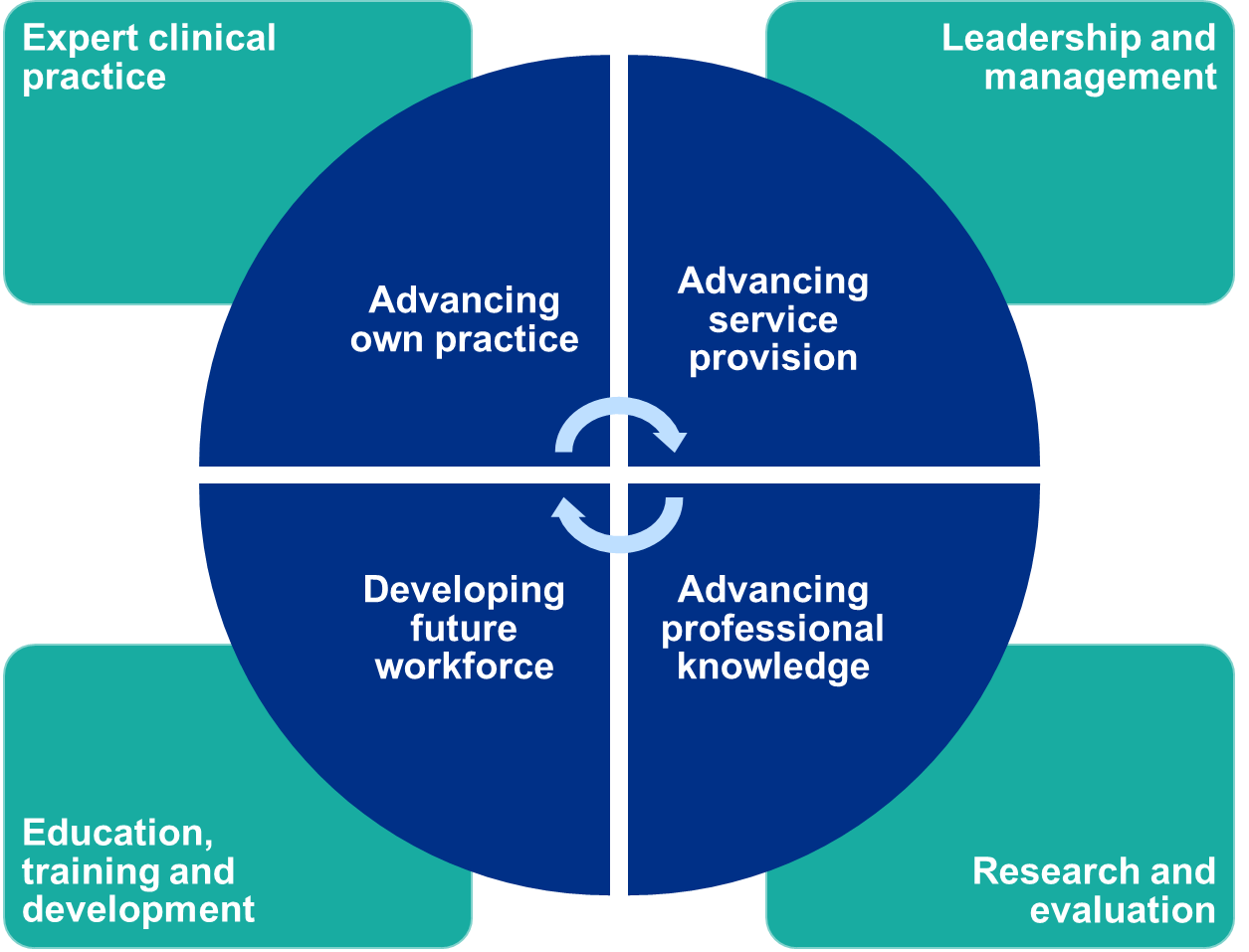
- The supervision of advanced practice development across the four pillars of advanced practice, (clinical expertise, research, education, leadership/management)
Estimated time to complete: 2 hours 15 minutes
Activity: NHS England Workplace Supervision for Advanced Practice videos (42mins)
This suite of videos prepared by The Centre for Advancing Practice in 2020 provides an introduction and overview of key points related to supervision within advanced practice that will be discussed more in depth throughout the workbook. There are seven fundamental principles for the supervision of developing advanced practitioners found in the Centre for Advancing Practice workplace supervision guidance as seen in diagram below.
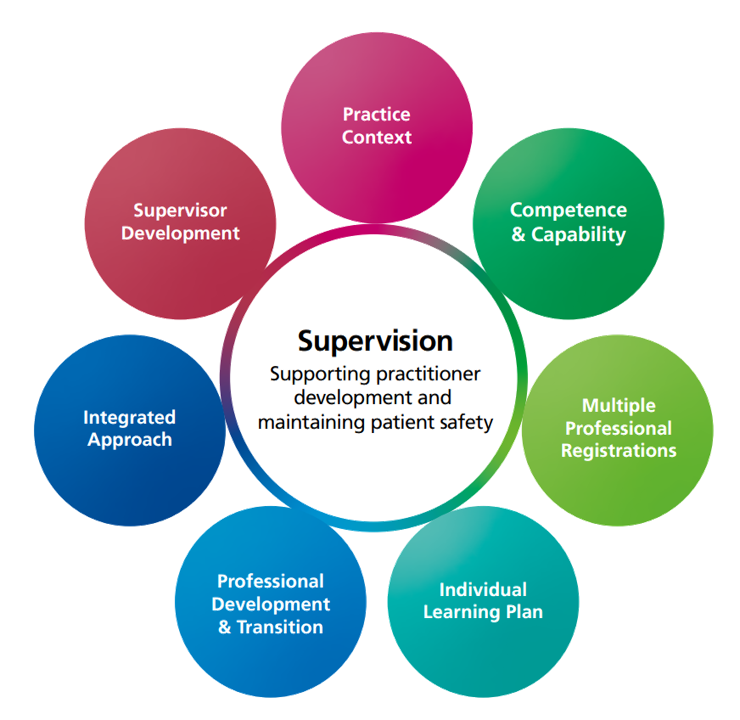
The following videos discuss the seven fundamental principles of supervision:
- Practice Context (2m26s)
- Competence and Capability (3m4s)
- Individual Learning Plan (5m15s)
- Integrated Approach (7m1s)
- Supervisor Development (6m44s)
- Final Thoughts (3m1s)
The supervision of advanced practice development across the four pillars of advanced practice
All advanced practitioners are expected to maintain advanced level practice portfolios across the four pillars (see diagram below). The trainee will require supervision spanning across the pillars. At various points, the HEI programme supervisor may provide supervision required to meet learning needs; however, it is important to keep portfolio evidence up to date as a supervisor, to maintain the knowledge, skills and behaviours to support trainees.
Activity: Thinking points (20mins)
Choose and complete one of the three thinking points below. You can use the box on the next page for your notes:
Thinking point 1:
How would you define supervision?
Thinking point 2:
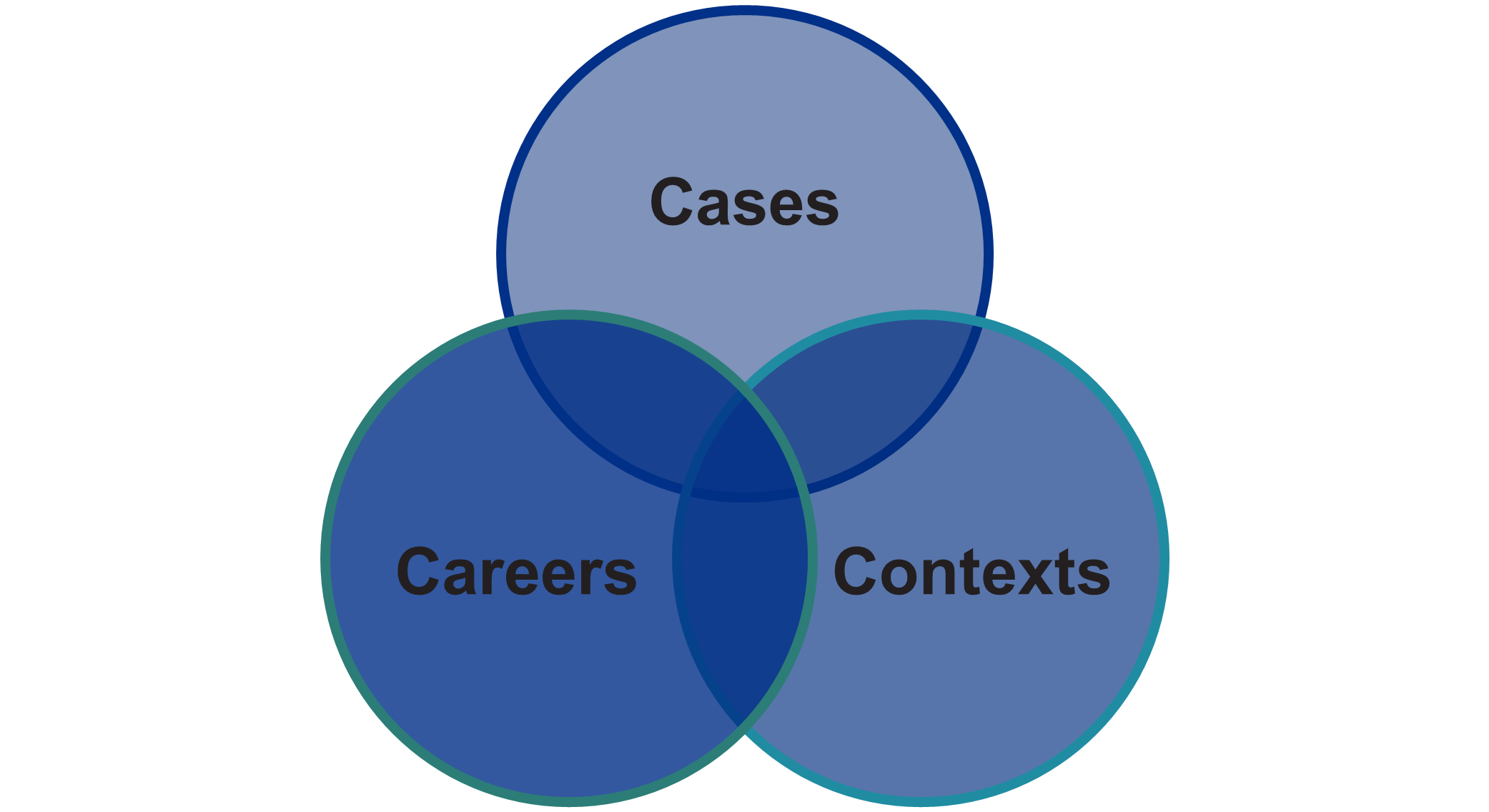
With reference to the diagram below, review your experiences of supervision and consider where you would ‘plot’ them in the Venn diagram.
- Where on the diagram is your emphasis?
- How might you extend your (or others’) practice to ensure supervision has a broader scope?
Thinking point 3:
Consider how you have prepared for supervision in the past:
Notes for activity: Thinking points

The advanced practice supervisor is expected to:
“Draw on understanding of different models, approaches, and modes of supervision, selecting, and applying those which will best support the trainee’s advanced level learning, development, and well-being (NHS England, 2023).”
Areas of focus in this section:
- Models of supervision
- How to incorporate models and approaches into supervision and how best to support learning and development of a trainee and/or advanced practitioner
Estimated time to complete: 1 hour 35 minutes
Incorporating models and approaches into supervision and how best to support learning and development of a trainee and/or advanced practitioner
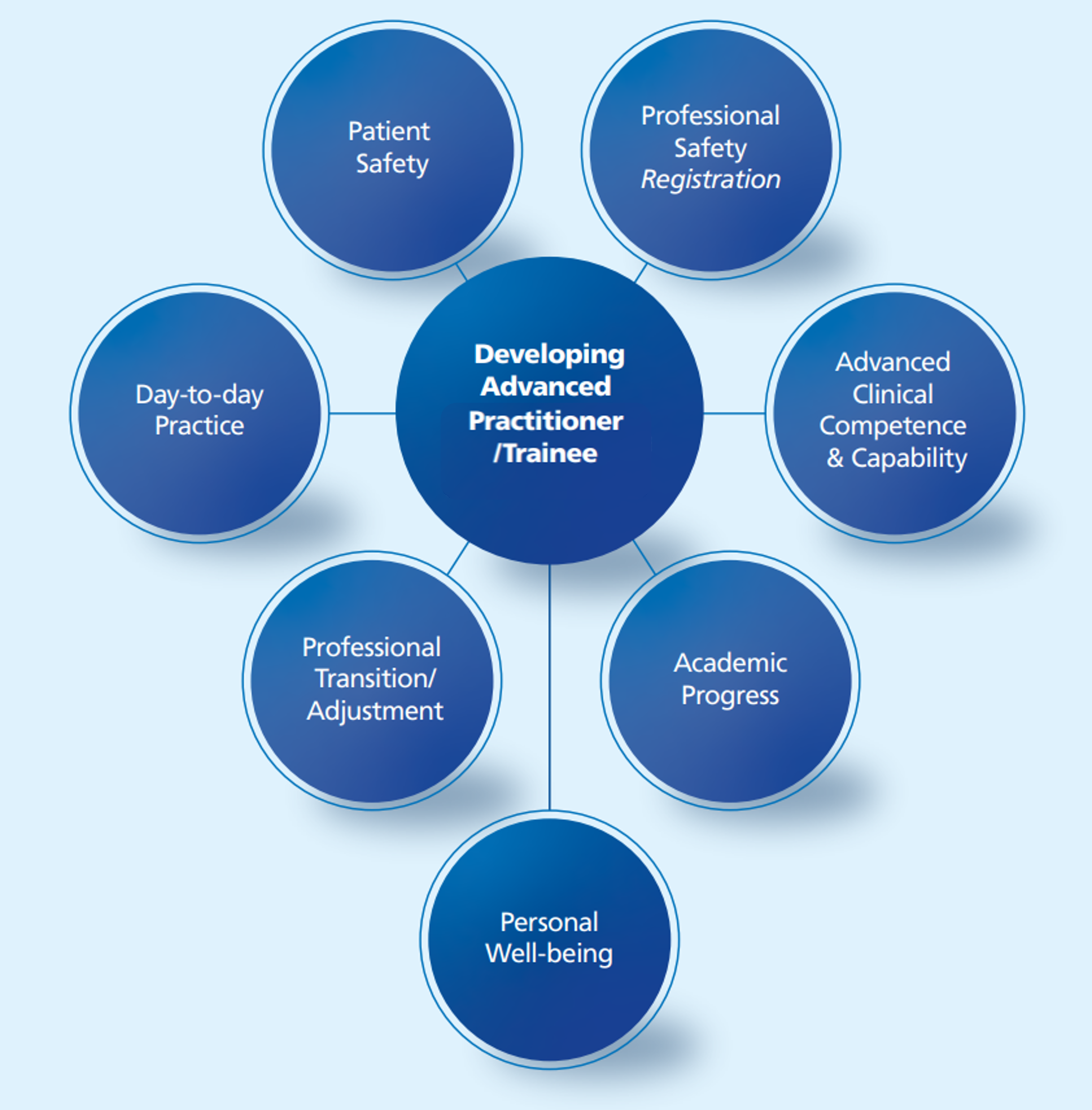
Models of supervision and frameworks can highlight criteria, dimensions of, and influences on the trainee’s/advanced practitioner’s practice and can guide the supervisor in their support; however, this does not guarantee appropriate or effective supervision. The diagram below highlights the different aspects of developing an advanced practitioner which should be considered by the supervisor. These aspects are not exhaustive; each will be explored throughout the advanced practitioner supervisor training resources.
 Dr. Deborah Harding, (2019), states: “Ultimately, supervision is perceived to be optimal when both supervisor and supervisee care about and care to resolve practice uncertainties or developmental needs, and when supervisor and supervisee adopt a cluster of facilitative behaviours and characteristics. Practitioners who display these characteristics can be described as ‘permeable practitioners’; they expect and anticipate uncertainty in day-to-day practice and seek to resolve uncertainties in a variety of reflective and learning activities, one of which may be supervision.”
While it is important to have regular protected time for supervision, it is the perceived quality and not the quantity of the supervision which will determine the adequacy and effectiveness of that supervision. The supervisor, along with the trainee/advanced practitioner, will mutually agree on the frequency and duration of the supervision. This will be based on the trainee’s/advanced practitioner’s current capabilities and learning needs, as well as the organisational service requirements. The supervisor should be responsive to the above but ensure both professional and public safety are paramount.

The advanced practice supervisor is expected to:
“Select and apply models and theories to support workplace advanced level skills learning and acquisition, adjusting approaches to match the trainee’s level of knowledge, skills development, and experience (NHS England, 2023).”
Areas of focus in this section
- Theoretical perspectives about learning and skills acquisition as applied to adult learners.
- The application of theoretical perspectives to workplace supervision of advanced practice.
Estimated time to complete: 55 minutes
Theoretical perspectives about learning and skills acquisition as applied to adult learners
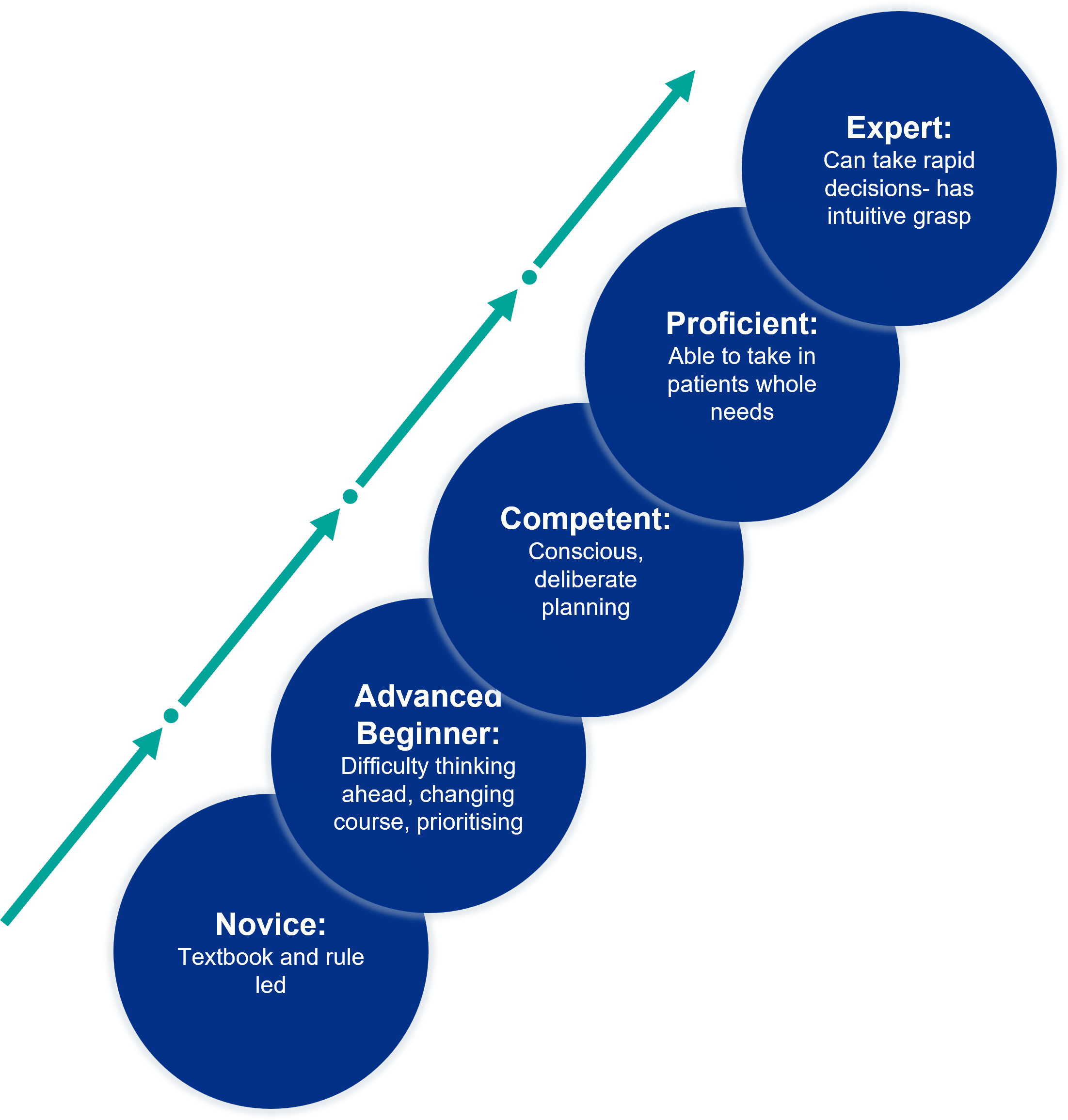
Models of supervision are sometimes accompanied by models of professional development and skills’ acquisition. Those of Benner (1984) (adapted from the Dreyfus Model of Skill Acquisition, 1980) and Peyton (1998) are routinely cited.
Benner presented a theoretical framework titled “From Novice to Expert” (1984) which addresses the different stages of professional growth of nurses specifically, but has been used in other clinical professions, see diagram below.
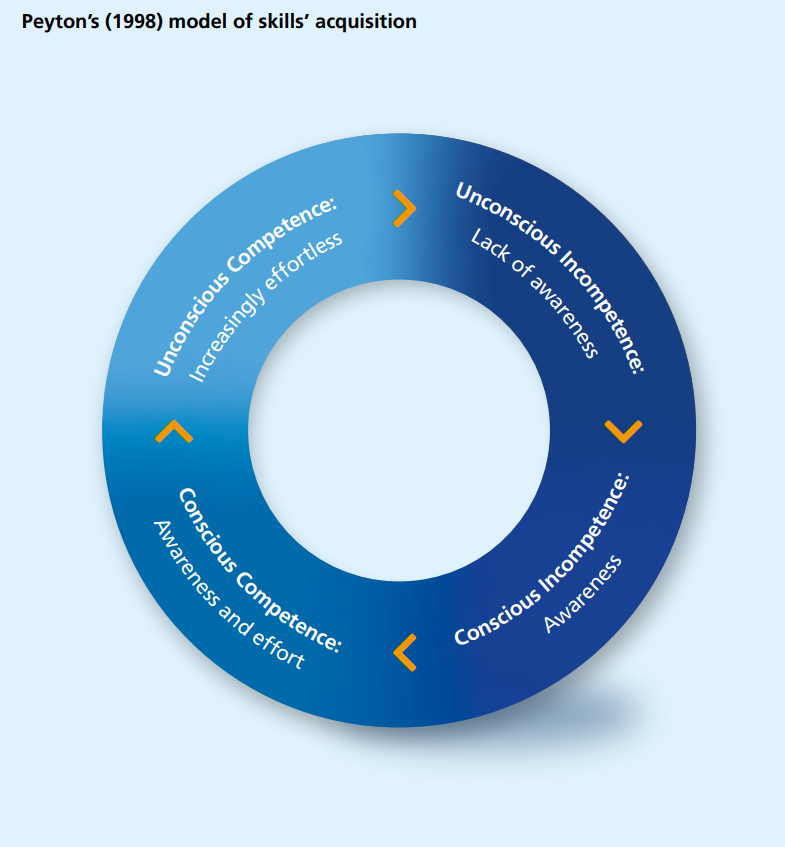
Peyton’s approach, see diagram below, outlines a 4-step approach to teaching incorporating the following steps of demonstration, deconstruction, comprehension, and execution (1998).
Some regard such models as too prescriptive, suggesting a final point or a ‘best place’ for the practitioner to be positioned (Dall’Alba and Barnacle, 2015).
Learning is a lifelong process and learning models have evolved over years; from learning models focused on the ‘educator-centred’ approach to ‘learner-centred’ approaches. Three main terms can describe how knowledge is acquired at various levels, see diagram below:
- Pedagogy – Educator-centred learning where a teacher imparts knowledge onto a learner and is usually structured in nature, such as in a primary school.
- Andragogy – Adult-centred learning where the learner is self-directed and has active participation in their education, includes case studies, practical examples. This term was coined by Knowles in 1968 to highlight the differences in adult learning compared with child-centre learning.
- Heutagogy – Self-directed learning where the learner directs their own studies based on curiosity and motivations.


The advanced practice supervisor is expected to:
“Apply understanding of critical reflection to support advanced level development, adjusting approaches to match the trainee’s level of development and experience and encouraging exploration of different approaches to support learning in and from practice (NHS England, 2023).”
Areas of focus in this section:
- Approaches to critical reflection
- The use of critical reflection to support advanced level learning
- Building on strengths, secure aspects of practice and prior learning and practice
Estimated time to complete: 40 minutes
Approaches to critical reflection

The advanced practice supervisor is expected to:
“Apply feedback, facilitation, communication skills, coaching approaches and techniques which build on the trainee’s strengths to encourage and ensure effective workplace learning, assessment and progression in advanced practice (NHS England, 2023).”
Areas of focus in this section:
- Feedback
- Coaching and mentoring
- Mediation and conflict
- Supporting a trainee with or in difficulty
Estimated Completion time: 2 hours 20 minutes
Feedback
As a supervisor, you will be required to give regular feedback to the learner while they develop as an advanced practitioner. This feedback is usually directly to the learner and will include both strengths and areas that require improvements. Below are three different tools that can be used to deliver feedback in a measured and considered way; they include the feedback sandwich, the SHARE debrief tool, and the BUILD model. Giving effective feedback will also be explored further in the practical day and will offer a chance to develop feedback skills in a safe environment.
- Feedback sandwich
The feedback sandwich starts and concludes with positive feedback, and what can be considered as the more critical feedback (or what may be classed as ‘negative’ feedback), is “sandwiched” between the positive aspects. This can be used in everyday clinical practice; however, if used continuously, it has the chance of becoming predictable. It can be useful to give positive feedback on its own when the opportunity arises. If coworkers feel acknowledged daily, they will be more open to all kinds of feedback when applicable (Hardevella et al, 2017).
- SHARE debrief tool
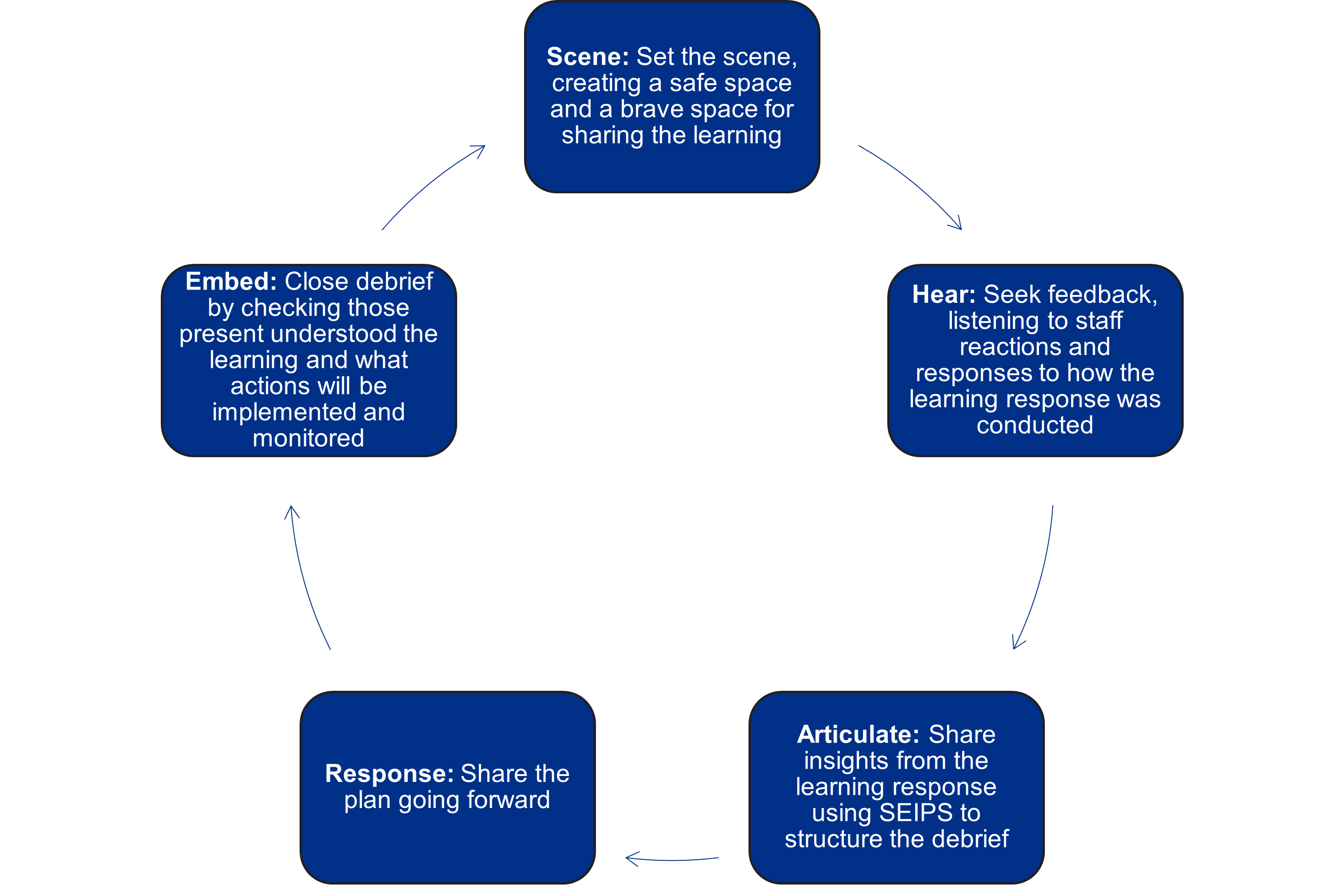
The SHARE debrief tool (NHS, 2022), see diagram below, supports health and care teams to engage teams and staff who may be affected by a learning response outcome.
It can be used to:
- present findings from a learning response (such as an incident investigation, MDT review and clinical huddle) and define and agree areas for improvement.
- collaboratively develop and prioritise safety actions in response to defined areas for improvement.
- corroborate thinking regarding safety actions before agreeing to implement them.
- debrief after the completion of learning.
- BUILD Model
The BUILD model (University of Otago, 2020) is a structured approach to giving feedback in a respectful and constructive manner. By utilising this model, feedback conversations can be more productive, less confrontational, and focused on growth and improvement. The BUILD model consists of 5 key steps as outlined in the table below:
| B | Describe the behaviour. Observations not judgments |
| U | Understand their context. Step into their shoes. Unsaid |
| I | Describe the impact on… you, others, outcomes or the work |
| L | Listen to them. “What was happening there?” (Don’t ask “why?”) |
| D | Ask “What might you do differently?” It’s a dialogue |
- ‘Behaviour’ sticks to facts rather than opinions or beliefs
- ‘Understand’ builds empathy before providing feedback
- ‘Impact’ provides clarity on the consequences
- ‘Listen’ by asking open questions and actively without interrupting or passing judgement
- ‘Do differently’ encourages self-reflection and empowers the individual to come up with solutions

The advanced practice supervisor is expected to:
“Provide inclusive, learner-focused supervision, which incorporates ways to recognise and support person specific factors including any protected characteristics, personal circumstances, and specific learning needs, to guide progress through a personal learning plan towards advanced level capability across the pillars of practice (clinical, research, education, and leadership/management), in the relevant speciality, pathway or setting including where relevant, a specified curriculum, credential specification and relevant higher education institution (university) requirements.
Support advanced level development and progress in a specified aspect of advanced level capability (as describing in the personal learning plan) through inclusive, learner-focused supervision which incorporates ways to support and navigate person specific factors including any protected characteristics, personal circumstances and specific learning needs equitably.
Provide and/or ensure access to restorative supervision and coaching to support transition to advanced level practitioner as necessary (NHS England, 2023).”
Areas of focus in this section:
- Equality, diversity and inclusion
- Learning difference/neurodiversity
- Developing individual learning plans
- Health and well-being
Estimated time to complete: 3 hours 25 minutes
Equality, diversity, and inclusion
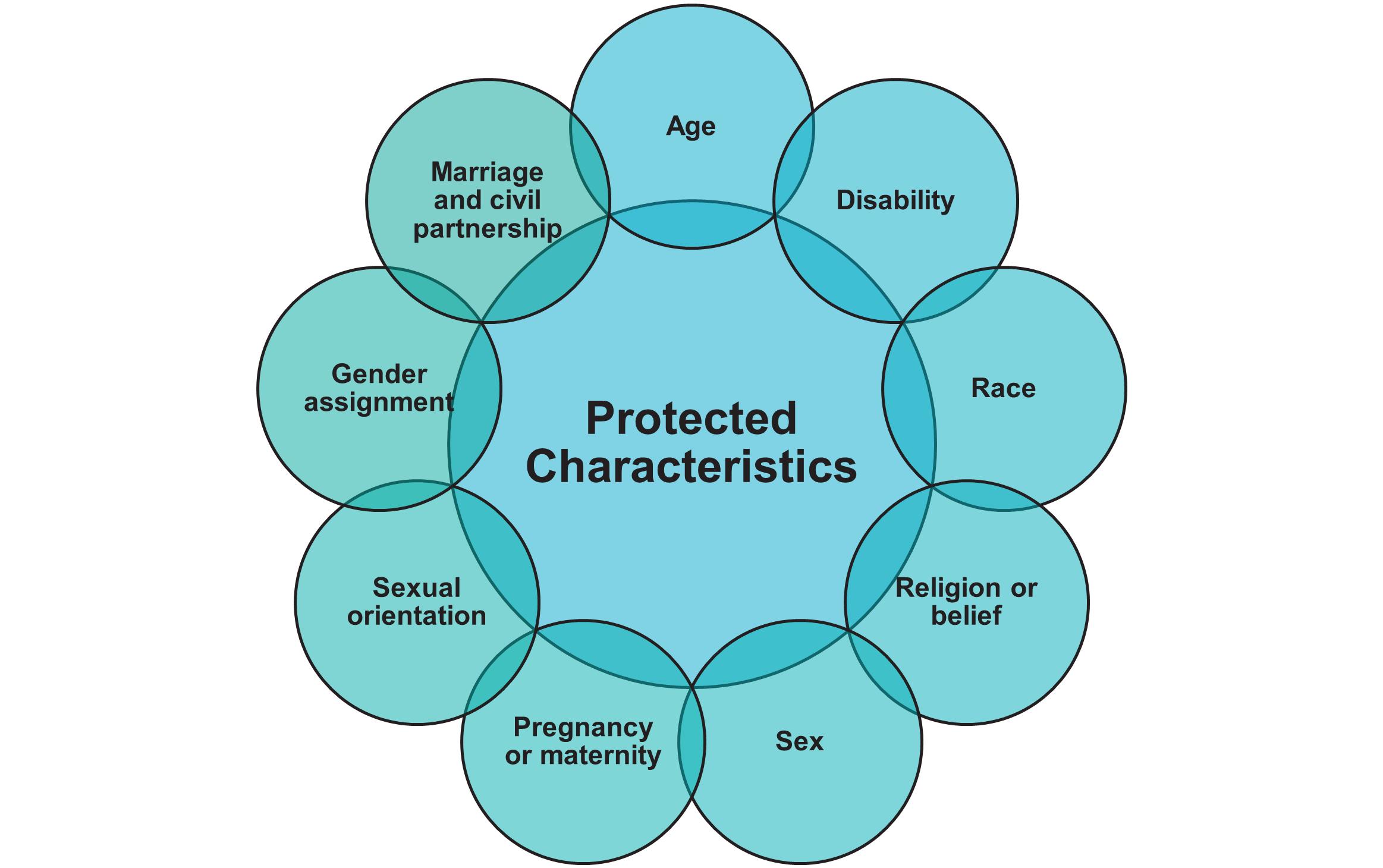
Equality, diversity, and inclusion (EDI) is ‘everyone’s business’ as described by the NHS England EDI improvement plan (2023). As you are aware there are 9 protected characteristics under the Equality Act 2010 as shown in the diagram below below. The NHS EDI improvement plan has 6 high impact actions with related success measures.
Measures that advanced practice supervisors can take to support trainees from an EDI background include:
This list is not exhaustive and if any support is required to improve on equality, diversity, or inclusion measures, your local EDI champion or lead can support. To find out more about NHS England’s approach to diversity and inclusion, please access: Diversity & Inclusion (NHS England, 2023).For a deeper dive: Leadership Listens, episode 5: The importance of compassion and inclusion (NHS Leadership Academy, 2022).
Developing individual learning plans (or personal development plans PDP)
An individual learning plan or personal development plan (PDP) is an action/learning plan with objectives based on self-awareness, values, reflection, goal setting, and planning for training or career development. Advanced practice trainees are encouraged to review learning, goals, and achievements on a regular basis throughout training and development. Learning outcomes should be clear, realistic, desirable, and achievable. A first step is to look at strengths, preferences, values, and preferred learning styles. For more information please see: Personal development planning.
Developing an individual learning plan or PDP begins with an appraisal of the trainee’s learning needs:
- Understanding existing professional knowledge, skills, experiences, behaviours, and characteristics.
- Agreeing which aspects of the existing knowledge, skills, experiences, behaviours, and characteristics must be augmented in training and off-the-job, to ensure competent, capable, safe, and effective advanced clinical practice.
- A baseline against which to track and record development in the specified capabilities and competences for the target advanced clinical practice role.
- The acknowledged added value different professional registrations bring the practice setting for patient benefit.
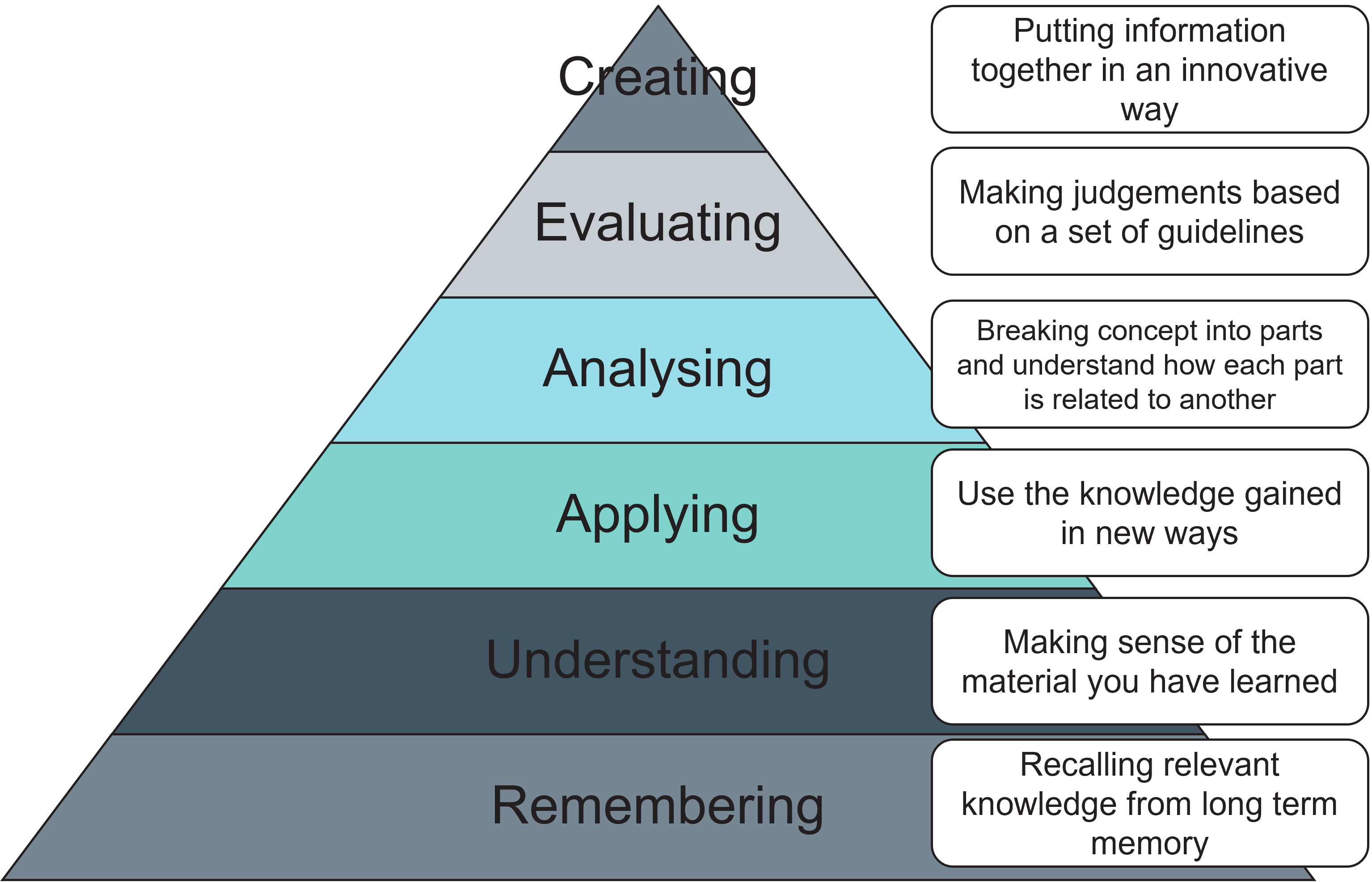
Supervisors are often required to work with individual trainees to set formal learning objectives with regards to knowledge, skills or behaviour learning needs. Using a framework, such as Bloom’s Taxonomy (1956, 2001) (see diagram below), is an effective way to structure how educational objectives are agreed and defined for the cognition of knowledge, moving through the remembering, comprehension, application, analysis, synthesis and evaluation of information.
It is important to consider the current level of the trainee’s knowledge, skill, and behaviours as well as the stage the trainee is at in their advanced practice education. It is advisable that SMART goals to increase success in achieving the learning outcomes are set and will be explored in the in-person or virtual teaching session.
SMART stands for specific, measurable, achievable, realistic, and time-based. Example SMART objectives log (NHS England, 2021).

The advanced practice supervisor is expected to:
“Adopt and model behaviours which establish a conducive, inclusive workplace learning environment and organisational culture to support advanced level development, innovative and culturally competent practice (NHS England, 2023).”
Areas of focus in this section:
- Establishing a supervision agreement/commitment
- Fostering and modelling trust, collaboration, dialogue
Estimated time to complete: 1 hour 35 minutes

The advanced practice supervisor is expected to:
“To support and empower the trainee to take responsibility for identifying, prioritising, and addressing individual advancing practice learning needs.
Recognise and act when the trainee’s personal, professional, or advanced practice learning needs are outside of the supervisor’s scope of practice. Making referrals for appropriate support (coordinating education supervisor, academic supervisor, staff support, psychological support, counselling) or capability specific associate supervision as required.
Act as a role model by maintaining own capability in the relevant practice setting, in accordance with own professional registration, and engage in continuing professional development as a supervisor and educator.” (NHS England, 2023)
Areas of focus in this section
- Supervisor as a registrant
- Supervisee/ trainee/ learner as registrant
- Professional regulatory bodies and registrant responsibility
Estimated time to complete: 55 minutes
Professional regulatory bodies and registrant responsibility
Trainees and advanced practitioners should have relevant competencies and capabilities to work safely within their scope of practice. Scope of practice refers to the boundaries within practice based on level of education, training, and competencies/capabilities and defines the duties and responsibilities that can be legally undertaken. It is essential for multi-professional advanced practitioners to operate within those defined scopes of practice to ensure patient safety, personal safety, organisational safety and delivery of quality care. This is underpinned by maintaining competencies/capabilities that are discussed and signed off during the annual appraisal process.
For further information relating to patient safety, please access: The NHS Patient Safety Strategy.
Employers also have responsibilities for ensuring adequate supervision and training for employees. Please review this document: Health and Care Act 2008- regulations 12 & 18.
Registrant accountability in advanced practice refers to the responsibility of health care professionals working at advanced level to make decisions in a context of complexity, uncertainty, and varying risk, and to have accountability for decisions made (HEE, 2017).
Advanced practice development takes place in a live and dynamic clinical setting with multiple stakeholders from clinical, operational, and educational governance organisations. Each stakeholder’s immediate governance focus may differ; however, the overarching aim is to support practitioner development while ensuring safe and effective care. Organisations have a liability to ensure appropriate governance for advanced practitioners.
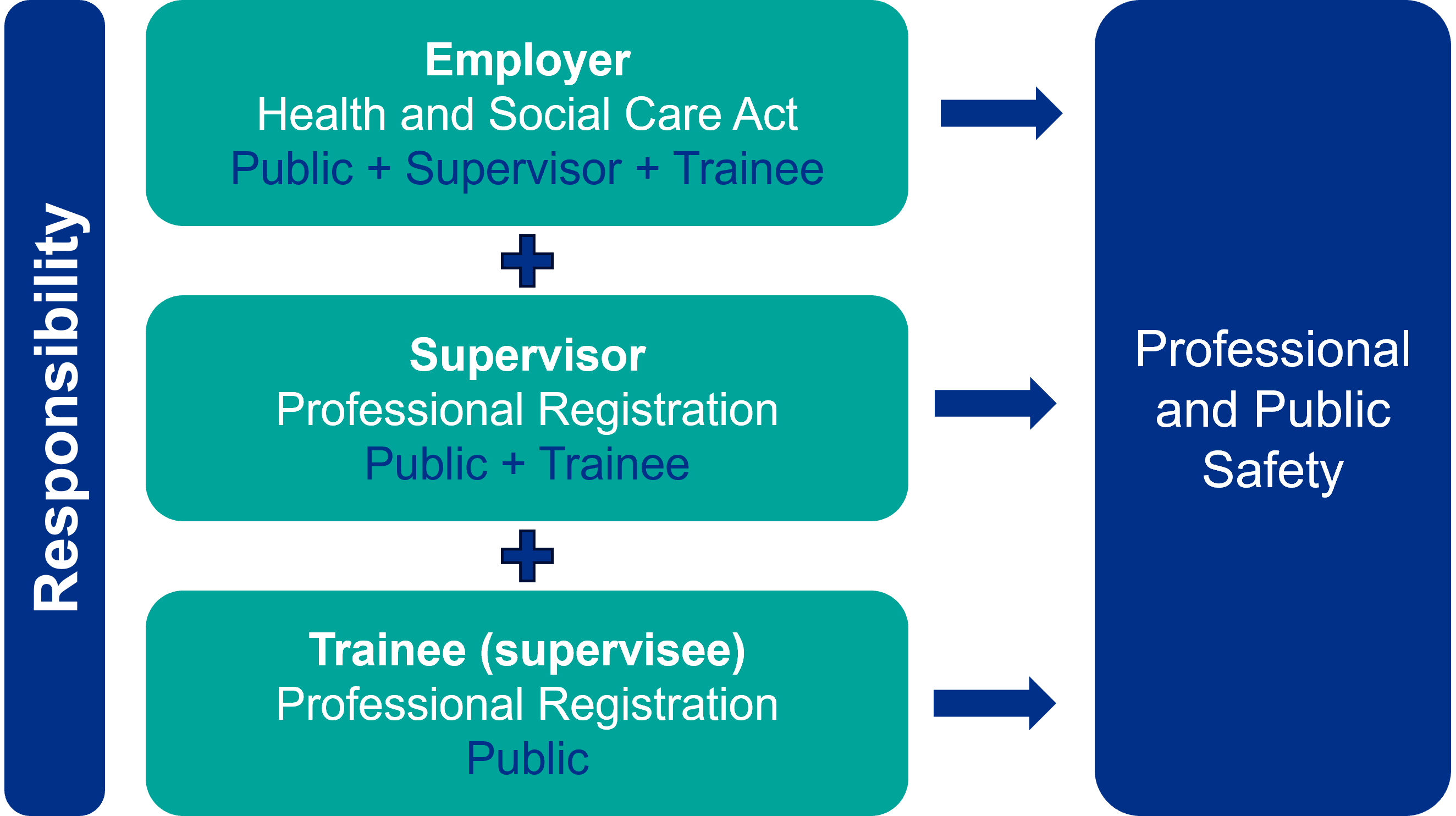
Supervisors should know and ensure trainees are aware of the organisational/ICB governance frameworks/policies and procedures and trust/practice requirements. The clinical governance that is in place is to protect both patient and professional safety, see diagram below:

The advanced practice supervisor is expected to:
“Recognise the advanced practice learner as an experienced registered professional augmenting existing competence and capability to an advanced level, adjusting supervision approach for different starting points and building on strengths and existing knowledge, skills, and behaviours.
Establish a clear and agreed understanding of multi-professional factors which are relevant for the trainee’s advanced practice development and supervision across the pillars of practice, ensuring these are reflected in the personal learning plan to include factors which may be specific to supervision between practitioners from different professions and/or registrations (NHS England, 2024).”
Areas of focus in this section:
- Different registrations, prior experience, expectations of supervision
- Integrated multi-professional team culture for supervision
Estimated time to complete: 1 hour 15 minutes

The advanced practice supervisor is expected to:
“Work collaboratively with education providers to ensure valid, fair and reliable assessment and verification of workplace capabilities, combining, as required, with skilful feedback, facilitation, coaching and mentoring to support trainee progression.
Select and apply valid, fair, and reliable modes of workplace assessment and verification of advanced level capabilities consistent with curriculum and education provider requirements (NHS England, 2023).”
Areas of focus in this section:
- Assessment techniques and assessments
- Maintaining supervision capabilities
- Portfolio evidence
Estimated time to complete: 1 hour 50 minutes
Assessment techniques and assessments
Assessments are an essential part of the learning process within a clinical learning environment, allowing the trainee to receive direct feedback about progress through understanding certain knowledge, or developing expected skills or behaviours. The supervisor’s feedback will indicate the trainee’s progress made, strengths noted, and areas of improvement required to meet the learning outcomes set. Assessments can be classed into formative and summative, and each assessment method will vary in terms of validity, fairness, and reliability.
The table below shows similarities and differences between formative and summative assessments. As a supervisor advanced practice trainees will require support with the completion of practice assessment documents and workplace-based assessments. Some examples of workplace-based assessments have been linked with videos to be watched. These videos are directed towards pharmacists; however, the content is relevant for multi-professional use.
|
|
Formative |
Summative |
|
Purpose |
Assessment of learning of knowledge, skill, or behaviour |
Assessment as part of an HEI |
|
Time Frame |
Occurs during the learning process or programme |
Occurs at the end of learning process or programme |
|
Measurement |
Direct feedback for strengths and areas for improvement |
Pass or fail marking system |
|
Tool examples |
· Case-Based Discussion (CBD) (5m35s) · Direct Observation of Practical Skills (DOPs) (6m03s) · Mini Clinical Evaluation Exercise (Mini Cex) (6m32s) · Clinical observation tools (COTs) |
· Essay · Examination · Observed Structured Clinical Examinations (OSCE) · Presentation · Project |

Appendix E – Trainees in need of support
General principles

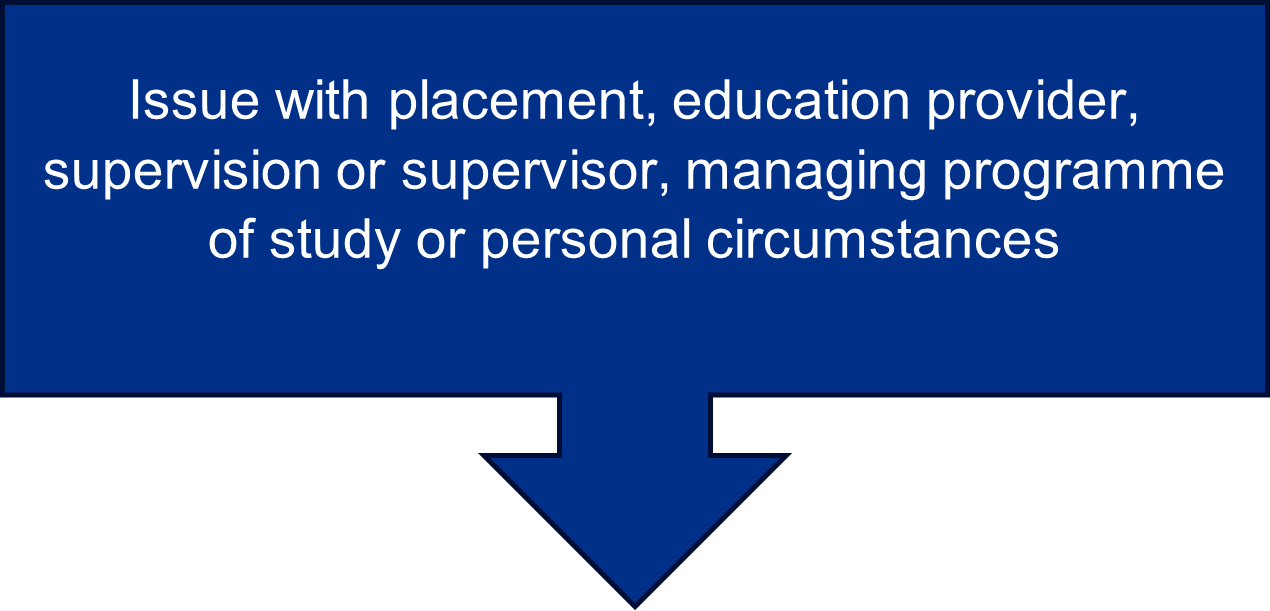
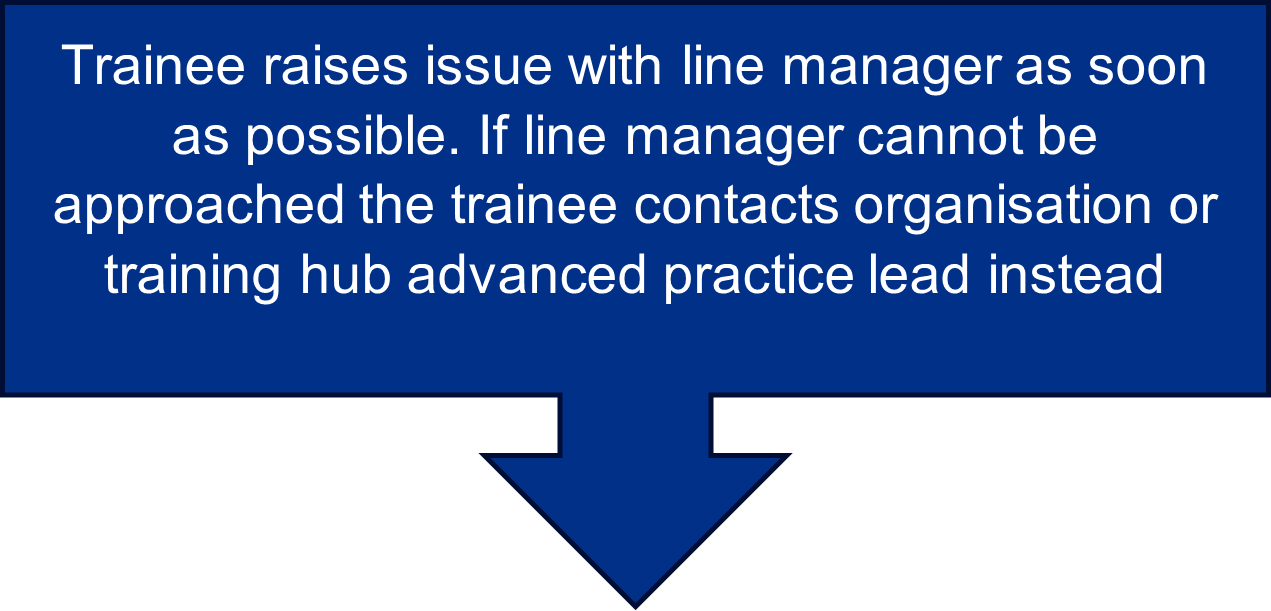
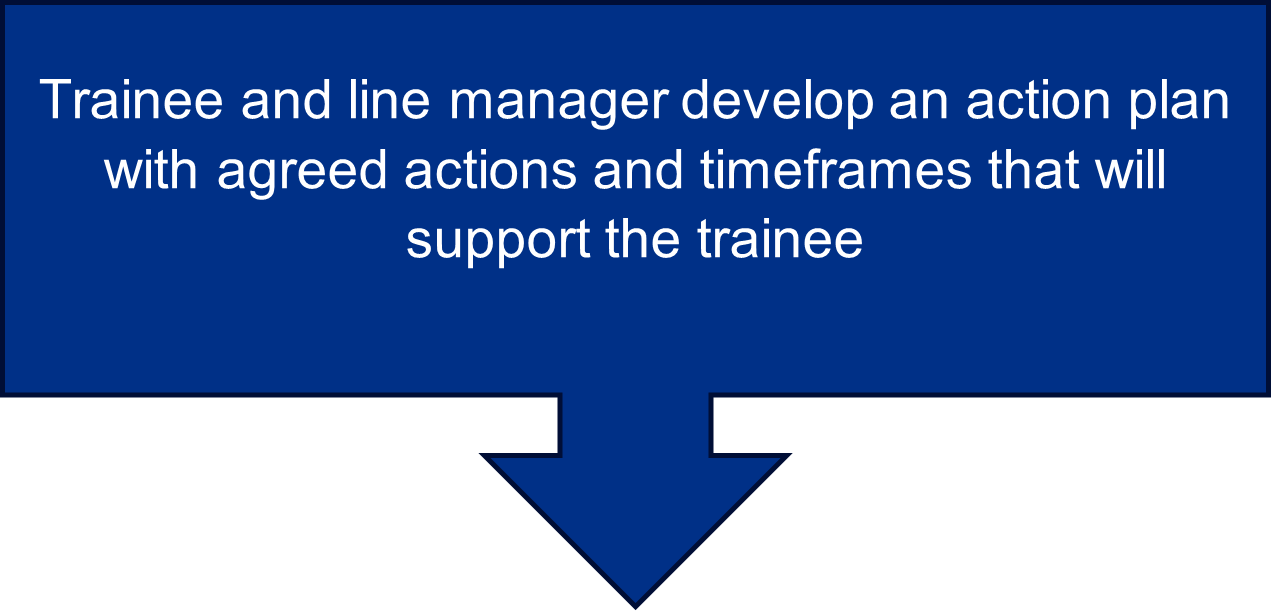
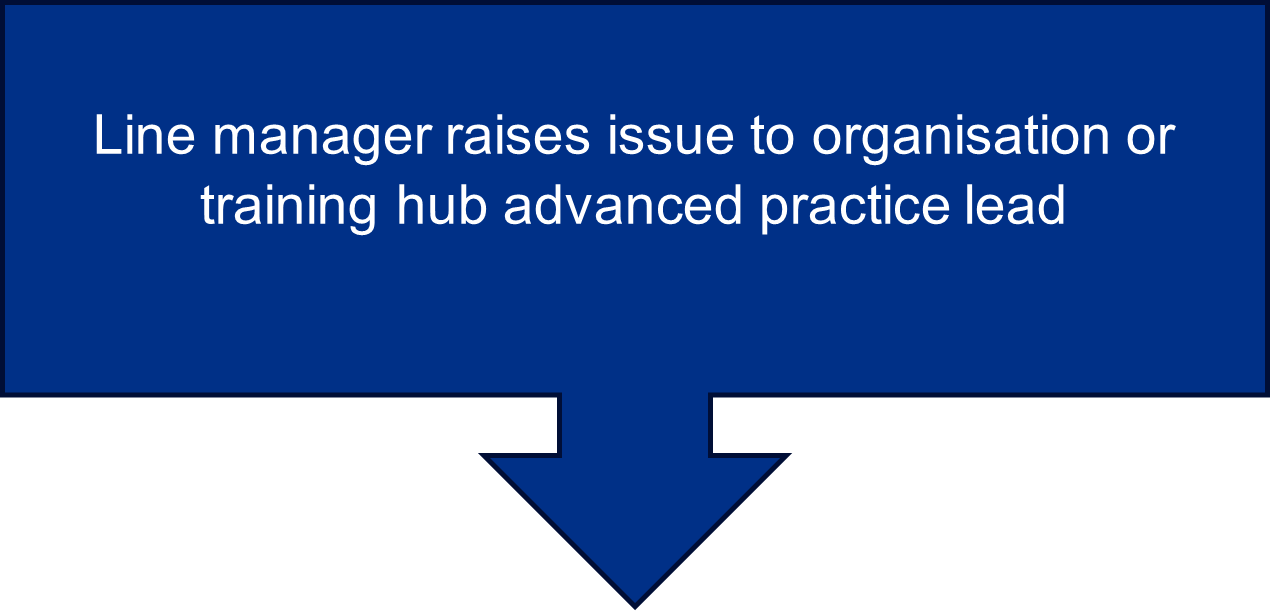

Trainees requiring support with education provider
There is an expectation for all advanced practice trainees to be proactive in managing their learning journey. This includes acting to manage and resolve problems that may occur during their training programme, with the support of their manager, supervisor, organisational/training hub advanced practice lead, MSc programme lead, and the NHS England – East of England Faculty for Advancing Practice.
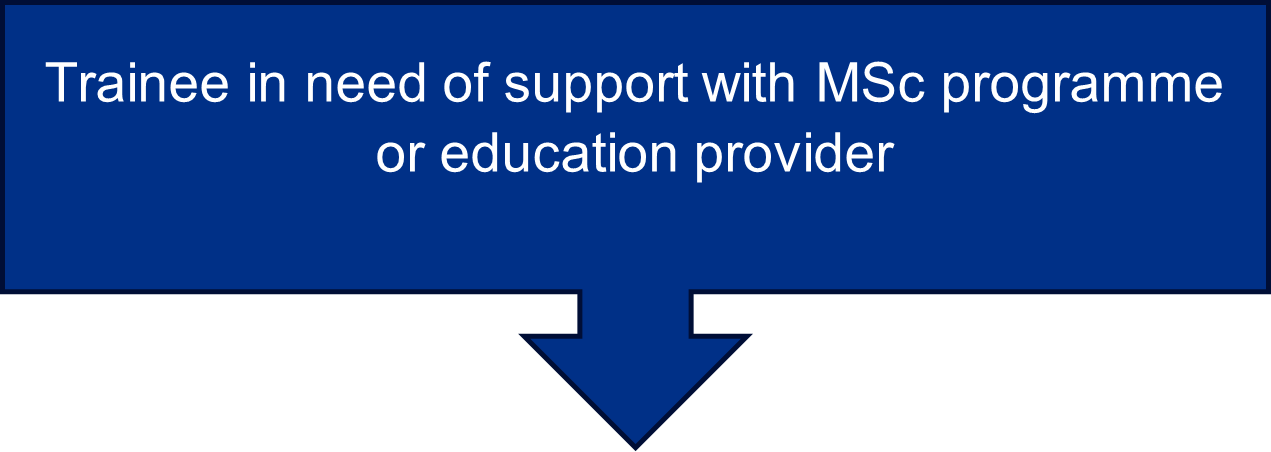
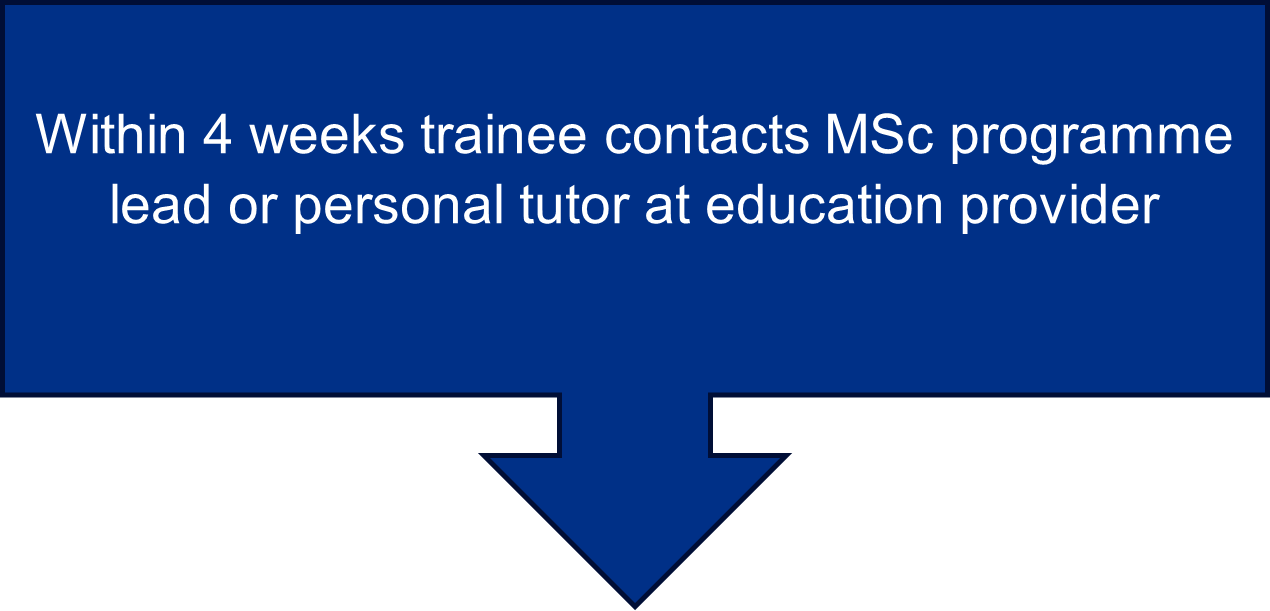
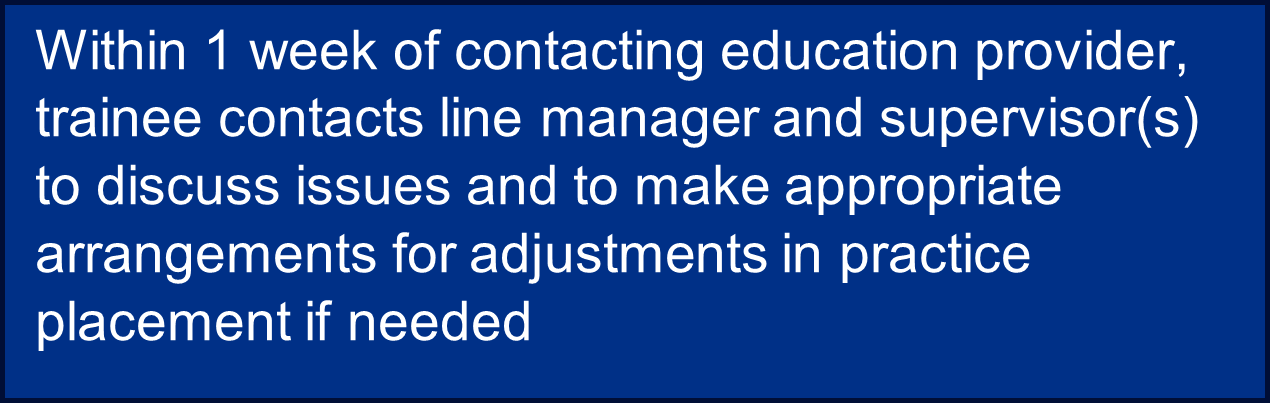
The trainee must report to their line manager and organisation or training hub advanced practice lead immediately if they:
- intend to the leave the programme
- defer on assignments or need to resubmit assignments. These may be education provider assignments or practice placement assignments, portfolios, skills, etc.
- have difficulties in attending required study days, and or are unable to attend
- are considering requesting a deferment, to intermit or pause on their programme
The line manager and advanced practice lead must report any of the above to the NHS England – East of England Faculty for Advancing Practice via england.eoeapfaculty@nhs.net within 7 days of being informed.
Trainees in receipt of NHS England funding who are planning a complete or temporary withdrawal from programme must report this immediately to NHS England via a notification of change form.
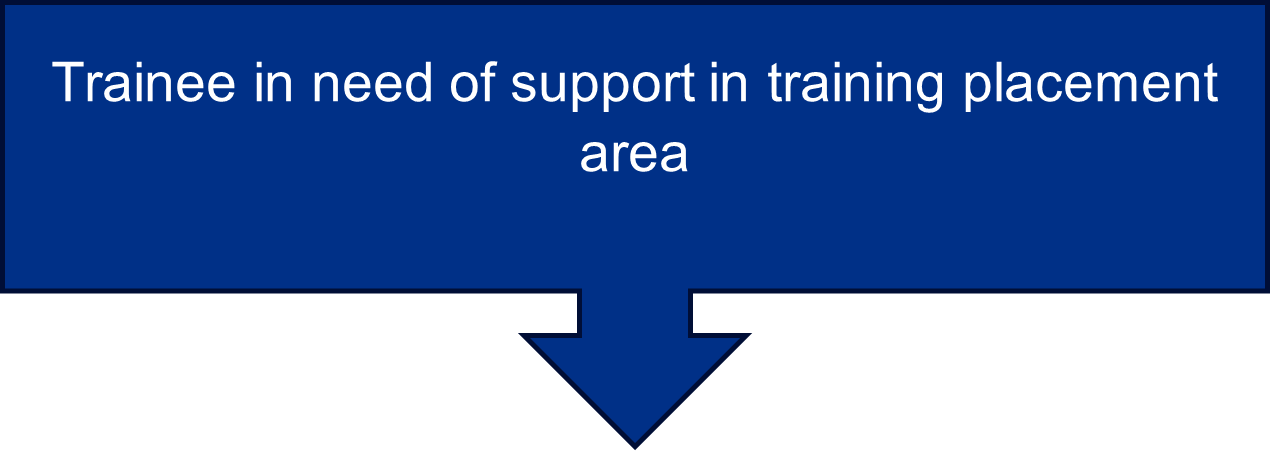
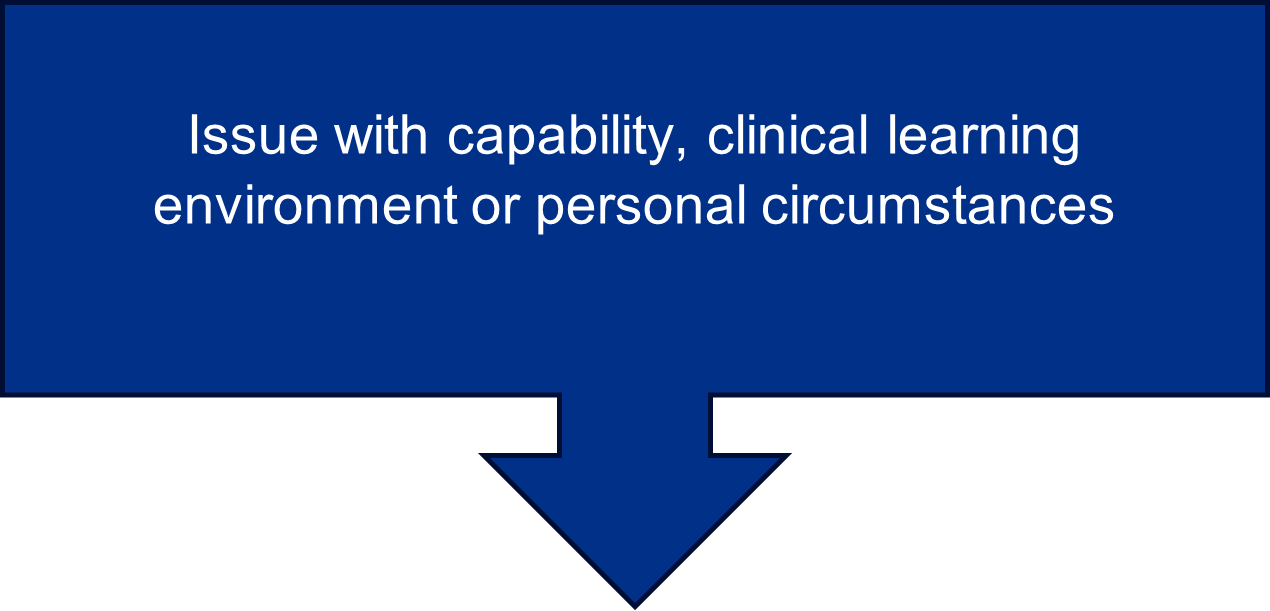
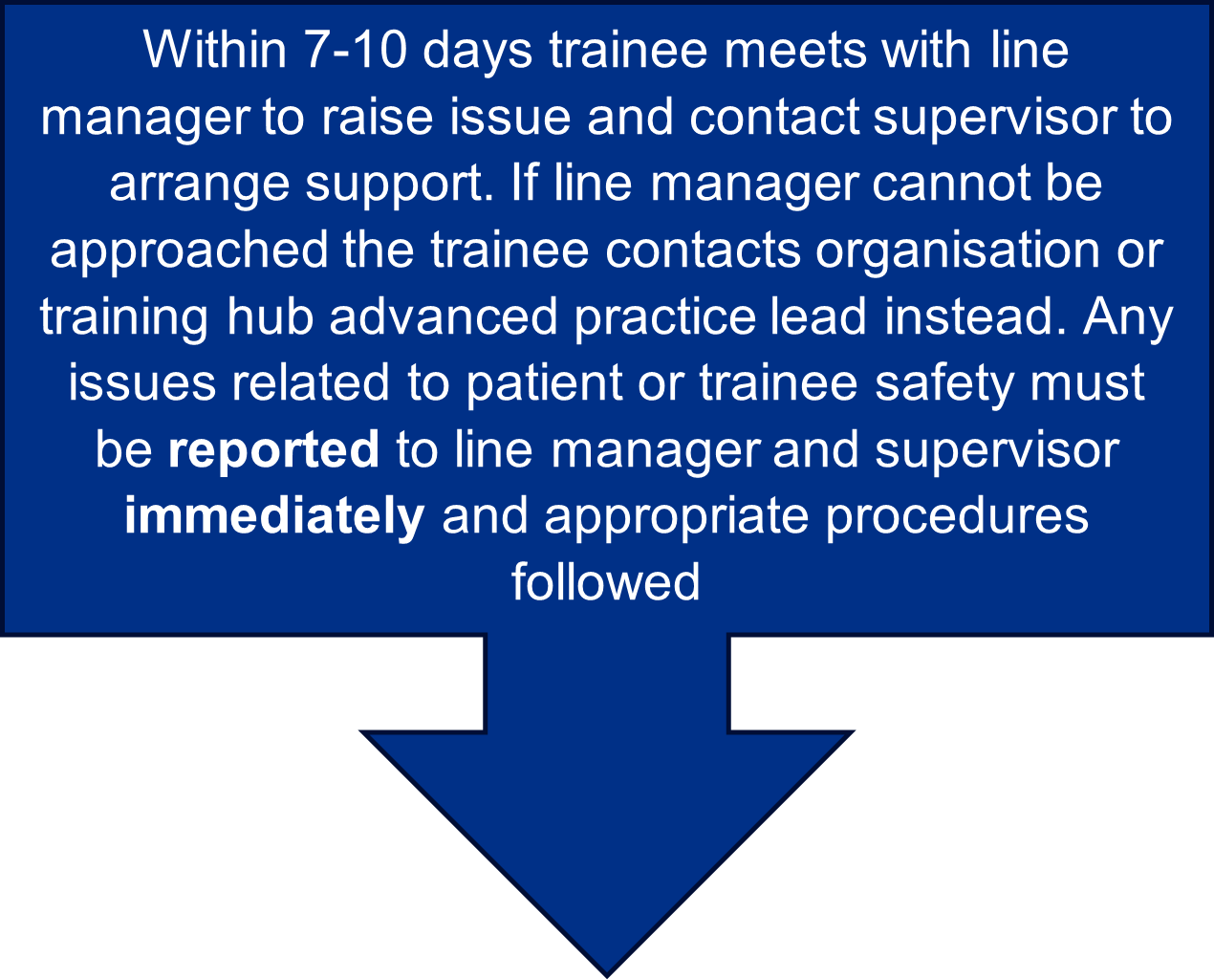
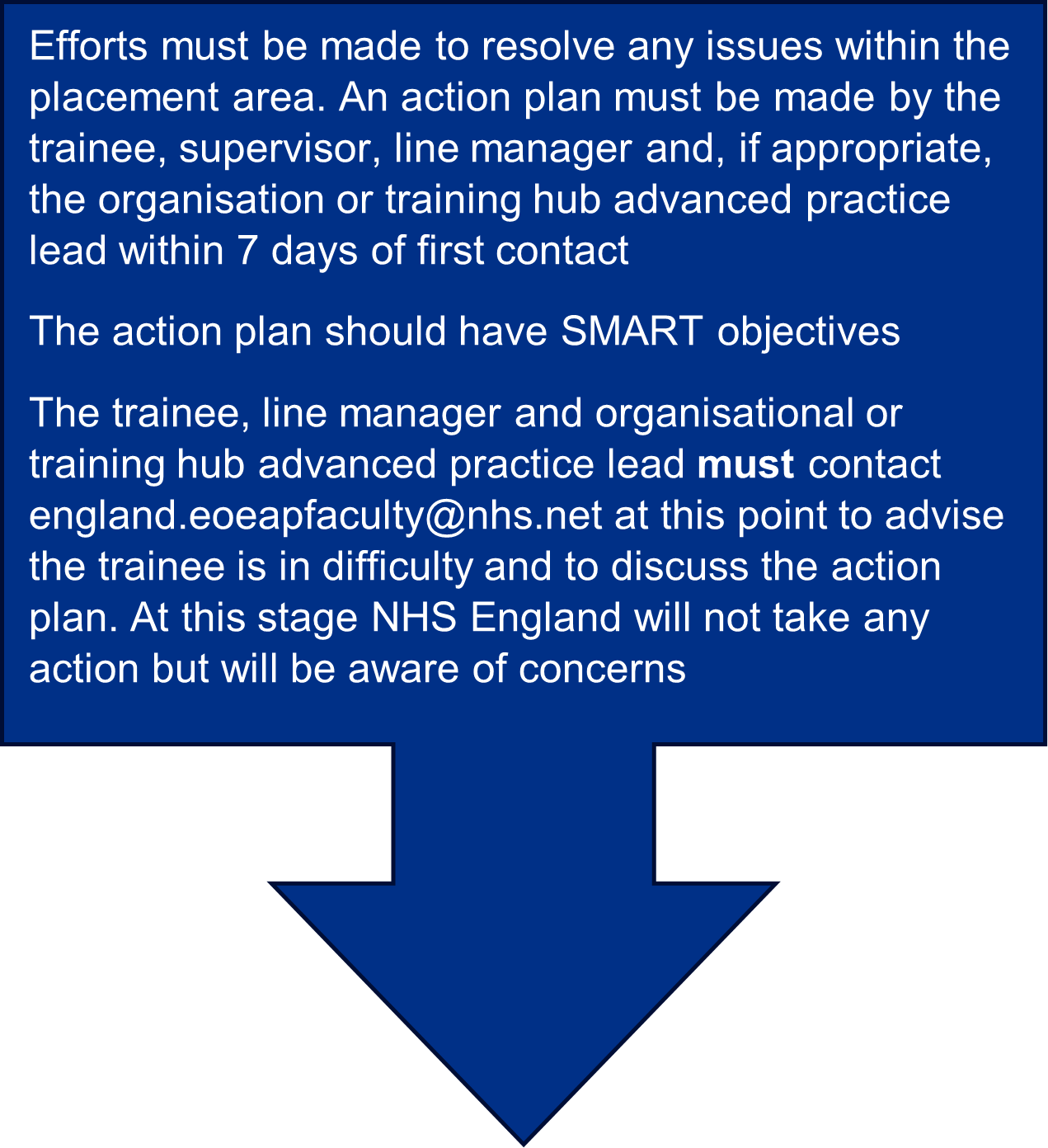
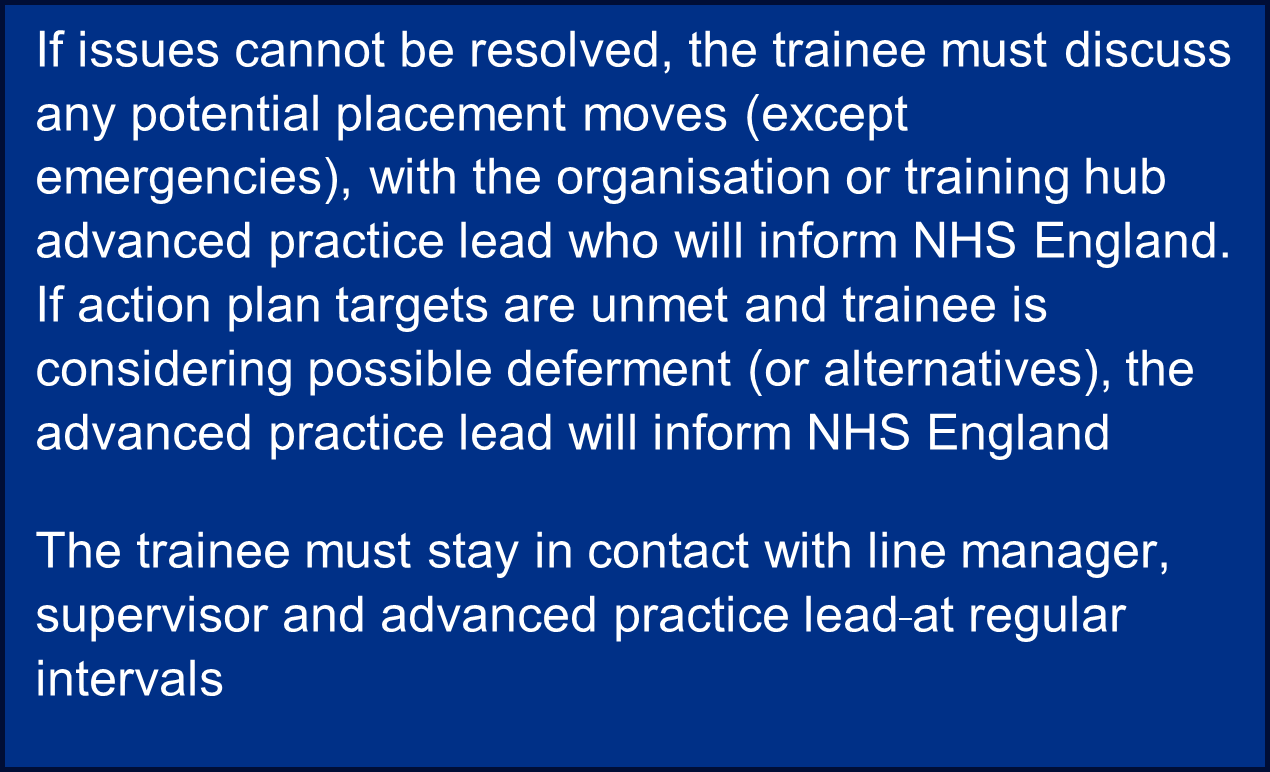
Trainees requiring support in placement areas
There is an expectation for all advanced practice trainees to be proactive in managing their learning journey. This includes acting to manage and resolve problems that may occur during training, with the support of their line manager, supervisor, organisational advanced practice lead, MSc programme lead, and the NHS England – East of England Faculty for Advancing Practice.

References
Department of Health and Social Care (2025). 10 Year Health Plan for England. Available at: 10 Year Health Plan for England – GOV.UK (Accessed 13/01/2026)
Argyris, C., & Schön, D. A. (1978). Organisational learning: A theory of action perspective. Available at: https://archive.org/details/organizationalle00chri (Accessed 20/12/24)
Benner, P. (1984). From novice to expert, excellence, and power in clinical nursing practice. Menlo Park, CA: Addison-Wesley Publishing Company, (p 307).
Bloom, B. S. (1956). Taxonomy of educational objectives. Vol. 1: Cognitive domain. New York: McKay, (p20, 24).
Bloom’s Taxonomy (revised 2001). (2024). Available at: Blooms Taxonomy:: Resource for Educators (Accessed 23/10/24).
Boud, D., Keogh, R., & Walker (Eds.). (1987). Reflection: Turning Experience into Learning. Available at: https://craftingjustice.wordpress.com/wp-content/uploads/2017/04/david-boud-rosemary-keogh-david-walker-reflection_-turning-experience-into-learning-routledge-1985-pp-1-165.pdf (Accessed 20/12/24)
Brockbank, A., & McGill, I. (2007). Facilitating reflective learning in higher education (2nd ed). New York: McGraw-Hill and Open University Press.
Brookfield S. D. (2000). The concept of critically reflective practice. In Wilson A. L., Hayes E. R. (Eds.), Handbook of adult and continuing education (pp. 33-49). San Francisco, CA: Jossey-Bass.
CDC. (2018). Adult Learning Assumptions. Available at: https://www.youtube.com/watch?v=hEp13DLuAU8&t=29s Accessed 10/09/24).
Cutrer, W. B., Atkinson, H.G., Friedman, E., Deiorio, N., Gruppen, L.D., Dekhtyar, M., et al. (2018). Exploring the characteristics and context that allow Master Adaptive Learners to thrive. Med Teach Taylor & Francis. 40:791–796. Available at: [PubMed] [Google Scholar] Exploring the characteristics and context that allow Master Adaptive Learners to thrive – PubMed (nih.gov) (Accessed 10 October 2024)
Dreyfus, S. (2004). The Five-Stage Model of Adult Skill Acquisition. Available at: https://journals.sagepub.com/doi/abs/10.1177/0270467604264992 (Accessed 10/09/24)
East London NHS Foundation Trust. (2022). Respectful resolution. Available at: https://www.elft.nhs.uk/sites/default/files/2022-10/elft_rr_-_step_3_-_direct_feedback_230421.pdf. (Accessed 23/05/2024)
E-Learning for Healthcare. (2020b). Diversity, Equal Opportunities and Human Rights. Available at: https://portal.e-lfh.org.uk/Component/Details/725230. (Accessed 15/04/24)
E-Learning for Healthcare. (2020a). Effective Feedback. Available at: https://portal.e-lfh.org.uk/Component/Details/725842. (Accessed 28/03/24)
E-Learning for Healthcare. (2020). Supervision. Available at: https://portal.e-lfh.org.uk/LearningContent/Launch/725430. (Accessed 28/01/24)
E-Learning for Health. (2017). Trainees with Difficulties. Available at: https://portal.e-lfh.org.uk/Component/Details/725848 (Accessed 22/01/24)
General Pharmaceutical Council (GMC). (2024). Standards and Guidance for Pharmacy Professionals. Available at: https://www.pharmacyregulation.org/pharmacists/standards-and-guidance-pharmacy-professionals (Accessed 04/04/24)
Ghaye, T. (2000). Into the reflective mode: bridging the stagnant moat. Available at: https://www.researchgate.net/publication/290809298_Into_the_reflective_mode_bridging_the_stagnant_moat (Accessed 20/12/24)
Gibbs, G. (1988). Learning by doing: a guide to teaching and learning methods. Available at: https://stephenp.net/wp-content/uploads/2015/12/learning-by-doing-graham-gibbs.pdf (Accessed 20/12/24)
Hardavella G, Aamli-Gaagnat A, Saad N, Rousalova I, Sreter KB. (2017). How to give and receive feedback effectively. Available at: https://pubmed.ncbi.nlm.nih.gov/29209427/ (Accessed 20/12/24)
Health & Care Professions Council. (2023). Standards of Proficiency. Available at: https://www.hcpc-uk.org/standards/standards-of-proficiency/ (Accessed 15/01/24)
Health Education England. (2022). East of England Clinical Learning Environment Strategy. Available at: https://healtheducationengland.sharepoint.com/:w:/g/Comms/Digital/EZNqrkxsBJRAkzpaafkJvxoB0hLldnCNssOo3hv6kLJ4-A?rtime=nGIYxgoh3Ug (Accessed 4/10/2024)
Health Education England. (2023). Guide to Practice-Based Learning (PBL) for Neurodivergent Students. Available at: https://www.hee.nhs.uk/sites/default/files/documents/Guide%20to%20Practice-Based%20Learning%20%28PBL%29%20for%20Neurodivergent%20Students.pdf (Accessed 04/04/24)
Health Education England. (2020). Minimum Standards for Supervision. Available at: https://advanced-practice.hee.nhs.uk/our-work/supervision/minimum-standards-for-supervision/#:~:text=Supervisors%3A%201%20Come%20from%20the%20multi-professional%20workforce%20and,development%2C%20assessment%20and%20verification%20of%20competence%20and%20capability (Accessed 22/01/24)
Health Education England. (2023). Personal Development Plan. Available at: https://london.hee.nhs.uk/sites/default/files/personal-development-plan-interactive.pdf (Accessed 21/03/24)
Health Education England. (2024) Reflective Practice Resources. Available at: https://nshcs.hee.nhs.uk/resource/nshcs-reflective-practice-resources/ (Accessed 21/03/24)
Health Education England. (2022). Supervisor Readiness Checklist. Available at: https://advanced-practice.hee.nhs.uk/wp-content/uploads/sites/28/2022/11/Supervisor-readiness-checklist.pdf (Accessed 30/5/24)
Health Education England. (2021). Workplace Supervision for Advanced Practice. Available at: https://advanced-practice.hee.nhs.uk/workplace-supervision-for-advanced-clinical-practice-2/ (Accessed 29/01/24)
Jarvis, P. (1992). Reflective practice and nursing. Nurse Education Today, 12(3), 174-181.
Legislation.gov.uk. (2024). Equality Act 2010. Available at: https://www.legislation.gov.uk/ukpga/2010/15/contents (Accessed 20/12/24)
Legislation.gov.uk. (2024). The Health and Social Care Act 2008. Available at: https://www.legislation.gov.uk/uksi/2014/2936/contents/made (Accessed 20/12/24)
Mann et al. (2023). Exploring the role of advanced clinical practitioners (ACPs) and their contribution to health services in England: A qualitative exploratory study. Available at: https://www.sciencedirect.com/science/article/pii/S1471595323000082 (Accessed 20/12/24)
Mezirow J. (1978). Perspective transformation. Adult Education Quarterly, 28, (p100-110)
Mukhalalati, B, & Taylor, A. (2019). Adult Learning Theories in Context: A Quick Guide for Healthcare Professional Educators. Available at: https://www.ncbi.nlm.nih.gov/pmc/articles/PMC6458658/ , (Accessed 3/6/24).
NHS. (2024). The NHS values. Available at: https://www.healthcareers.nhs.uk/working-health/working-nhs/nhs-constitution (Accessed 12/20/24)
NHS Employers. (2022). Clinical Supervision models for registered professionals. Available at: https://www.nhsemployers.org/articles/clinical-supervision-models-registered-professionals (Accessed 31/5/24)
NHS England. (2023). Advanced Practice Supervisor Capabilities: Guiding Principles for Supervisor Learning and Development. Available at: https://advanced-practice.hee.nhs.uk/our-work/supervision/advanced-practice-supervisor-capabilities (Accessed 15/01/24)
NHS England. (2021). Case Based Discussion Available at: https://www.youtube.com/watch?v=WSLXrDhM1A0 (Accessed 18/9/24)
NHS England. (2021). Direct observation of practical skills. Available at: https://www.youtube.com/watch?v=jufTIsJHqPl (Accessed 18/9/24)
NHS England. (2022). Diversity and Inclusion: Our Strategic Framework 2018-2022. Available at https://www.hee.nhs.uk/our-work/diversity-inclusion/diversity-inclusion-our-strategic-framework-2018-2022 (Accessed 01/02/24)
NHS England. (2023). Educator Workforce Strategy. Available at: https://www.england.nhs.uk/publication/educator-workforce-strategy/ (Accessed 20/12/24)
NHS England. (2022). Effective Supervision for Advanced Practice and Minimum Standards Documentation. Available at: https://www.youtube.com/watch?v=YhdE8g7euPI&t=637s (Accessed 30/5/24)
NHS England. (2021). Example SMART (Specific, Measurable, Achievable, Realistic, Time-based) Objectives log. Available at: https://nshcs.hee.nhs.uk/publications/example-smart-specific-measurable-achievable-realistic-time-based-objectives-log/. (Accessed 14/03/24)
NHS England. (2019). Job planning the clinical workforce-allied health professionals, a best practice guide. Available at: https://www.england.nhs.uk/wp-content/uploads/2021/05/aps-job-planning-best-practice-guide-2019.pdf (Accessed 20/12/24)
NHS England. (2024). Looking after your team’s health and wellbeing guide. Available at: https://www.england.nhs.uk/long-read/looking-after-your-teams-health-and-wellbeing-guide/ (Accessed 20/12/24)
NHS England. (2017). Managing Conflicts of Interest in the NHS: Guidance for Staff and Organisations. Available at: https://www.england.nhs.uk/publication/managing-conflicts-of-interest-in-the-nhs-guidance-for-staff-and-organisations/. (Accessed 15/04/24)
NHS England. (2021). Mini Clinical Evaluation Exercise. Available at: https://www.youtube.com/watch?v=GjSlMnZBlto (Accessed 18/9/24)
NHS England. (2024). Overcoming Barriers to Supervision. Available at: https://advanced-practice.hee.nhs.uk/our-work/supervision/#Appendix-5 (Accessed 28/04/24)
NHS England. (2024a). Personal Development Planning. Available at: https://www.healthcareers.nhs.uk/career-planning/career-planning/developing-your-health-career/personal-development-planning (Accessed 21/04/24)
NHS England. (2023b). Professional nurse advocate A-EQUIP model: A model of clinical supervision for nurses. Available at: https://www.england.nhs.uk/publication/professional-nurse-advocate-a-equip-model-a-model-of-clinical-supervision-for-nurses/ (Accessed 13/03/24)
NHS England. (2024). Safe Learning Environment Charter-what good looks like. Available at: https://www.england.nhs.uk/long-read/safe-learning-environment-charter/ (Accessed 20/12/24)
NHS England. (2021). Supervision and Assessment Resources. Available at: https://advanced-practice.hee.nhs.uk/our-work/supervision/supervision-and-assessment-resources/ (Accessed 11/04/24)
NHS England. (2024e). Supervision: Developing Supervisors: features of existing supervisor training. Available at: https://advanced-practice.hee.nhs.uk/our-work/supervision/#7.4 (Accessed 01/05/24)
NHS England. (2023). The Importance of Supervision in Advanced Practice. Available at: https://www.youtube.com/watch?v=EW8azkw-kGU (Accessed 30/5/24)
NHS England. (2024). Transformative reflection. Available at: https://www.hee.nhs.uk/our-work/enhancing-generalist-skills/enhance-learning-resources/handbook/cross-cutting-themes/transformative-reflection (Accessed 14/03/24)
NHS England. (2021). Workplace Supervision for Advanced Clinical Practice. Available at: https://www.youtube.com/playlist?list=PLrVQaAxyJE3ewY1Hq6sBBkETQQ4q0hmFF (Accessed 29/05/24)
NHS England. (2022b). Workplace Supervision for Advanced Clinical Practice: Competence and Capability. Available at: https://www.youtube.com/watch?v=LDZGiuxg_Zk (Accessed 21/03/24)
NHS England. (2022a). Workplace supervision for advanced clinical practice – Individual Learning Plan. Available at: https://www.youtube.com/watch?v=uLdZUmPQX2s (Accessed 21/03/24)
NHS England. (2022c). Workplace Supervision for Advanced Clinical Practice: Multi-Professional Registration. Available at: https://www.youtube.com/watch?v=7iCmqSDpzNs (Accessed 21/03/24)
NHS England. (2022d). Workplace Supervision for Advanced Clinical Practice: Professional Development & Transition NHS England. Available at: https://www.youtube.com/watch?v=t_5XVZyM08s (Accessed 21/03/24)
NHS Improving Quality. (2022). Learning Handbook: Guidance and tools to support systemic before, during and after project activity in health and care. Available at: https://www.england.nhs.uk/improvement-hub/wp-content/uploads/sites/44/2015/08/learning-handbook-coaching.pdf (Accessed 08/04/24)
NHS Leadership Academy. (2022). Leadership Listens, Episode 5: The importance of compassion and inclusion. Available at: https://soundcloud.com/nhsleadership/leadership-listens-5 (Accessed 20/9/24)
Nursing & Midwifery Council. (2024). Stakeholder Engagement. Available at: https://www.nmc.org.uk/about-us/our-role/advanced-practice-review/stakeholder-engagement/ Pages 31-33 (Accessed 03/04/24)
Nursing & Midwifery Council .(2024a).Standards of Proficiency for Registered Nurses https://www.nmc.org.uk/standards/standards-for-nurses/standards-of-proficiency-for-registered-nurses/ (Accessed 29/01/24)
Read, K & Barton, I. (2016). Supporting Trainers of Trainees in Difficulty. Available at: https://heeoe.hee.nhs.uk/sites/default/files/trainer_support.pdf (Accessed 14/05/24)
Rothwell, C., Kehoe, A., Farook, S.F. and Illing, J. (2021). Enablers and Barriers to Effective Clinical Supervision in the Workplace: A Rapid Evidence Review. BMJ Open, 11(9), pp.1–10.
Singh M, Restivo A. (2023). Task Trainers in Procedural Skills Acquisition in Medical Simulation. [Figure, Peyton’s 4 steps to skilled learning Contribution by Maninder Singh, MD] Available from: https://www.ncbi.nlm.nih.gov/books/NBK558925/figure/article-63887.image.f1/ (Accessed 10/09/24)
Skrzypek, A., Górecki, T., Krawczyk, P., Podolec, M., Cebula, G., Jabłoński, K., Szeliga, M. and Nowakowski, M. (2018). Implementation of the modified four-step approach method for teaching echocardiography using the FATE protocol-A pilot study. Echocardiography, 35(11), pp.1705–1712.
The Chartered Institute of Personnel and Development. (2023). CIPD: Coaching and Mentoring. Available at: https://www.cipd.org/en/knowledge/factsheets/coaching-mentoring-factsheet/ (Accessed 08/04/24)
The Chartered Institute of Personnel and Development. (2023). CIPD: Mediation at work: Learn how mediation can resolve conflict in the workplace. Available at: https://www.cipd.org/uk/knowledge/factsheets/mediation-factsheet/ (Accessed 08/04/24)
The Chartered Institute of Personnel and Development. (2023). CIPD: Workplace Mediation. Available at: https://www.cipd.org/en/knowledge/factsheets/mediation-factsheet/ (Accessed 07/03/24)
The Health and Social Care Act. (2008). (Regulated Activities) Regulations. Available at: https://www.legislation.gov.uk/uksi/2014/2936/contents/made (Accessed 14/03/24)
University of BC. (2017). Adult Learning Theory. Available at: https://www.youtube.com/watch?v=cEktCWBI1JU (Accessed 10/9/24)
Argyris, C., & Schön, D. A. (1978). Organisational learning: A theory of action perspective. Available at: https://archive.org/details/organizationalle00chri (Accessed 20/12/24)
Benner, P. (1984). From novice to expert, excellence, and power in clinical nursing practice. Menlo Park, CA: Addison-Wesley Publishing Company, (p 307)
Bloom, B. S. (1956). Taxonomy of educational objectives. Vol. 1: Cognitive domain. New York: McKay, (p20, 24)
Bloom’s Taxonomy (revised 2001). (2024). Available at: www.bloomstaxonomy.net (Accessed 23/10/24)
Boud, D., Keogh, R., & Walker (Eds.). (1987). Reflection: Turning Experience into Learning. Available at: https://craftingjustice.wordpress.com/wp-content/uploads/2017/04/david-boud-rosemary-keogh-david-walker-reflection_-turning-experience-into-learning-routledge-1985-pp-1-165.pdf (Accessed 20/12/24)
Brockbank, A., & McGill, I. (2007). Facilitating reflective learning in higher education (2nd ed). New York: McGraw-Hill and Open University Press.
Brookfield S. D. (2000). The concept of critically reflective practice. In Wilson A. L., Hayes E. R. (Eds.), Handbook of adult and continuing education (pp. 33-49). San Francisco, CA: Jossey-Bass.
CDC. (2018). Adult Learning Assumptions. Available at: https://www.youtube.com/watch?v=hEp13DLuAU8&t=29s (Accessed 10/09/24).
Cutrer, W. B., Atkinson, H.G., Friedman, E., Deiorio, N., Gruppen, L.D., Dekhtyar, M., et al. (2018). Exploring the characteristics and context that allow Master Adaptive Learners to thrive. Med Teach Taylor & Francis. 40:791–796. Available at: [PubMed] [Google Scholar] https://pubmed.ncbi.nlm.nih.gov/30033795/ (Accessed 10 October 2024)
Department of Health and Social Care (2025). 10 Year Health Plan for England. Available at: 10 Year Health Plan for England – GOV.UK (Accessed 13/01/2026)
Dreyfus, S. (2004). The Five-Stage Model of Adult Skill Acquisition. Available at: https://journals.sagepub.com/doi/abs/10.1177/0270467604264992 (Accessed 10/09/24)
East London NHS Foundation Trust. (2022). Respectful resolution. Available at: https://www.elft.nhs.uk/sites/default/files/2022-10/elft_rr_-_step_3_-_direct_feedback_230421.pdf . (Accessed 23/05/2024)
E-Learning for Healthcare. (2020b). Diversity, Equal Opportunities and Human Rights. Available at: https://portal.e-lfh.org.uk/Component/Details/725230 . (Accessed 15/04/24)
E-Learning for Healthcare. (2020a). Effective Feedback. Available at: https://portal.e-lfh.org.uk/Component/Details/725842 . (Accessed 28/03/24)
E-Learning for Healthcare. (2020). Supervision. Available at: https://portal.e-lfh.org.uk/LearningContent/Launch/725430 . (Accessed 28/01/24)
E-Learning for Health. (2017). Trainees with Difficulties. Available at: https://portal.e-lfh.org.uk/Component/Details/725848 (Accessed 22/01/24)
General Pharmaceutical Council (GMC). (2024). Standards and Guidance for Pharmacy Professionals. Available at: https://www.pharmacyregulation.org/pharmacists/standards-and-guidance-pharmacy-professionals (Accessed 04/04/24)
Ghaye, T. (2000). Into the reflective mode: bridging the stagnant moat. Available at: https://www.researchgate.net/publication/290809298_Into_the_reflective_mode_bridging_the_stagnant_moat (Accessed 20/12/24)
Gibbs, G. (1988). Learning by doing: a guide to teaching and learning methods. Available at: https://stephenp.net/wp-content/uploads/2015/12/learning-by-doing-graham-gibbs.pdf (Accessed 20/12/24)
Hardavella G, Aamli-Gaagnat A, Saad N, Rousalova I, Sreter KB. (2017). How to give and receive feedback effectively. Available at: https://pubmed.ncbi.nlm.nih.gov/29209427/ (Accessed 20/12/24)
Health & Care Professions Council. (2023). Standards of Proficiency. Available at: https://www.hcpc-uk.org/standards/standards-of-proficiency/ (Accessed 15/01/24)
Health Education England. (2022). East of England Clinical Learning Environment Strategy. Available at: https://www.hee.nhs.uk/sites/default/files/documents/CLE%20Strategy%20EoE%20-%20WEB.pdf (Accessed 4/3/26)
Health Education England. (2023). Guide to Practice-Based Learning (PBL) for Neurodivergent Students. Available at: https://www.hee.nhs.uk/sites/default/files/documents/Guide%20to%20Practice-Based%20Learning%20%28PBL%29%20for%20Neurodivergent%20Students.pdf (Accessed 04/04/24)
Health Education England. (2024). Models of Reflection and Reflective Practice. Available at: https://london.hee.nhs.uk/reflective-writing-models-reflection-and-reflective-practice (Accessed 21/03/24)
Health Education England. (2023). Personal Development Plan. Available at: https://london.hee.nhs.uk/sites/default/files/personal-development-plan-interactive.pdf (Accessed 21/03/24)
Jarvis, P. (1992). Reflective practice and nursing. Nurse Education Today, 12(3), 174-181.
Legislation.gov.uk. (2024). Equality Act 2010. Available at: https://www.legislation.gov.uk/ukpga/2010/15/contents (Accessed 20/12/24)
Legislation.gov.uk. (2024). The Health and Social Care Act 2008. Available at: https://www.legislation.gov.uk/uksi/2014/2936/contents/made (Accessed 20/12/24)
Mann et al. (2023). Exploring the role of advanced clinical practitioners (ACPs) and their contribution to health services in England: A qualitative exploratory study. Available at: https://www.sciencedirect.com/science/article/pii/S1471595323000082 (Accessed 20/12/24)
Mezirow J. (1978). Perspective transformation. Adult Education Quarterly, 28, (p100-110)
Mukhalalati, B, & Taylor, A. (2019). Adult Learning Theories in Context: A Quick Guide for Healthcare Professional Educators. Available at: https://www.ncbi.nlm.nih.gov/pmc/articles/PMC6458658/ , (Accessed 3/6/24)
NHS. (2024). The NHS values. Available at: https://www.healthcareers.nhs.uk/working-health/working-nhs/nhs-constitution (Accessed 12/20/24)
NHS Employers. (2024) Clinical Supervision models for registered professionals. Available at: https://www.nhsemployers.org/articles/clinical-supervision-models (Accessed 31/01/26)
NHS England. (2023). Advanced Practice Supervisor Capabilities: Guiding Principles for Supervisor Learning and Development. Available at: https://advanced-practice.hee.nhs.uk/our-work/supervision/advanced-practice-supervisor-capabilities (Accessed 15/01/24)
NHS England (2025) Advanced practice workplace supervision: Minimum standards for supervision. NHS. Available online at: https://advanced-practice.hee.nhs.uk/resources/supervision-and-assessment-resources/
NHS England. (2021). Case Based Discussion Available at: https://www.youtube.com/watch?v=WSLXrDhM1A0 (Accessed 18/9/24)
NHS England. (2021). Direct observation of practical skills. Available at: https://www.youtube.com/watch?v=jufTIsJHqPl (Accessed 18/9/24)
NHS England. (2022). Diversity and Inclusion: Our Strategic Framework 2018-2022. Available at https://www.hee.nhs.uk/our-work/diversity-inclusion/diversity-inclusion-our-strategic-framework-2018-2022 (Accessed 01/02/24)
NHS England. (2023). Educator Workforce Strategy. Available at: https://www.england.nhs.uk/publication/educator-workforce-strategy/ (Accessed 20/12/24)
NHS England. (2022). Effective Supervision for Advanced Practice and Minimum Standards Documentation. Available at: https://www.youtube.com/watch?v=YhdE8g7euPI&t=637s (Accessed 30/5/24)
NHS England. (2021). Example SMART (Specific, Measurable, Achievable, Realistic, Time-based) Objectives log. Available at: https://nshcs.hee.nhs.uk/publications/example-smart-specific-measurable-achievable-realistic-time-based-objectives-log/ . (Accessed 14/03/24)
NHS England. (2019). Job planning the clinical workforce-allied health professionals, a best practice guide. Available at: https://www.england.nhs.uk/wp-content/uploads/2021/05/aps-job-planning-best-practice-guide-2019.pdf (Accessed 20/12/24)
NHS England. (2024). Looking after your team’s health and wellbeing guide. Available at: https://www.england.nhs.uk/long-read/looking-after-your-teams-health-and-wellbeing-guide/ (Accessed 20/12/24)
NHS England. (2017). Managing Conflicts of Interest in the NHS: Guidance for Staff and Organisations. Available at: https://www.england.nhs.uk/publication/managing-conflicts-of-interest-in-the-nhs-guidance-for-staff-and-organisations/ . (Accessed 15/04/24)
NHS England. (2021). Mini Clinical Evaluation Exercise. Available at: https://www.youtube.com/watch?v=GjSlMnZBlto (Accessed 18/9/24)
NHS England. (2025). Multi-professional framework for advanced practice in England. Available at: https://advanced-practice.hee.nhs.uk/ (Accessed 13/01/2026)
NHS England. (2026). Overcoming Barriers to Supervision. Available at https://advanced-practice.hee.nhs.uk/our-work/supervision/supervision-and-assessment-resources/barriers-to-supervision/ (Accessed 04/03/2026)
NHS England. (2024a). Personal Development Planning. Available at: https://www.healthcareers.nhs.uk/career-planning/developing-your-health-career/personal-development-planning (Accessed 21/04/24)
NHS England. (2023b). Professional nurse advocate A-EQUIP model: A model of clinical supervision for nurses. Available at: https://www.england.nhs.uk/publication/professional-nurse-advocate-a-equip-model-a-model-of-clinical-supervision-for-nurses/ (Accessed 13/03/24)
NHS England. (2026) Readiness for advanced practice: A guide for aspiring and trainee advanced practitioners. Available at: https://advanced-practice.hee.nhs.uk/regional-faculties-for-advancing-practice/regional-faculty-for-advancing-practice-east-of-england-2/guidance-and-resources/ (Accessed 13/01/26)
NHS England. (2025) Reflective practice resources. Available at: https://nshcs.hee.nhs.uk/resource/nshcs-reflective-practice-resources/ (Accessed 13/01/26)
NHS England. (2024). Safe Learning Environment Charter-what good looks like. Available at: https://www.england.nhs.uk/long-read/safe-learning-environment-charter/ (Accessed 20/12/24)
NHS England. (2026). Supervision and Assessment Resources. Available at: https://advanced-practice.hee.nhs.uk/our-work/supervision/supervision-and-assessment-resources/ (Accessed 04/03/26)
NHS England. (2024e). Supervision: Developing Supervisors: features of existing supervisor training. Available at: https://advanced-practice.hee.nhs.uk/our-work/supervision/#7.4 (Accessed 01/05/24)
NHS England (2025) Supervisor readiness checklist Health Education England. NHS. Available online at: https://advanced-practice.hee.nhs.uk/resources/supervision-and-assessment-resources/ (Accessed 4/3/26)
NHS England. (2023). The Importance of Supervision in Advanced Practice. Available at: https://www.youtube.com/watch?v=EW8azkw-kGU (Accessed 30/5/24)
NHS England. (2024). Transformative reflection. Available at: https://www.hee.nhs.uk/our-work/enhancing-generalist-skills/enhance-learning-resources/handbook/cross-cutting-themes/transformative-reflection (Accessed 14/03/24)
NHSE England. (2025) Workplace Supervision for Advanced Practice. Available at: https://advanced-practice.hee.nhs.uk/our-work/supervision/ (Accessed 13/01/2026)
NHS England. (2021). Workplace Supervision for Advanced Clinical Practice. Available at: https://www.youtube.com/playlist?list=PLrVQaAxyJE3ewY1Hq6sBBkETQQ4q0hmFF (Accessed 29/05/24)
NHS England. (2022b). Workplace Supervision for Advanced Clinical Practice: Competence and Capability. Available at: https://www.youtube.com/watch?v=LDZGiuxg_Zk (Accessed 21/03/24)
NHS England. (2022a). Workplace supervision for advanced clinical practice – Individual Learning Plan. Available at: https://www.youtube.com/watch?v=uLdZUmPQX2s (Accessed 21/03/24)
NHS England. (2022c). Workplace Supervision for Advanced Clinical Practice: Multi-Professional Registration. Available at: https://www.youtube.com/watch?v=7iCmqSDpzNs (Accessed 21/03/24)
NHS England. (2022d). Workplace Supervision for Advanced Clinical Practice: Professional Development & Transition NHS England. Available at: https://www.youtube.com/watch?v=t_5XVZyM08s (Accessed 21/03/24)
NHS Improving Quality. (2022). Learning Handbook: Guidance and tools to support systemic before, during and after project activity in health and care. Available at: https://www.england.nhs.uk/improvement-hub/wp-content/uploads/sites/44/2015/08/learning-handbook-coaching.pdf (Accessed 08/04/24)
NHS Leadership Academy. (2022). Leadership Listens, Episode 5: The importance of compassion and inclusion. Available at: https://soundcloud.com/nhsleadership/leadership-listens-5 (Accessed 20/9/24)
Nursing & Midwifery Council. (2024). Stakeholder Engagement. Available at: https://www.nmc.org.uk/about-us/our-role/advanced-practice-review/stakeholder-engagement/ Pages 31-33 (Accessed 03/04/24)
Nursing & Midwifery Council .(2024a).Standards of Proficiency for Registered Nurses https://www.nmc.org.uk/standards/standards-for-nurses/standards-of-proficiency-for-registered-nurses/ (Accessed 29/01/24)
Radical Candor (2026) Available at: https://www.radicalcandor.com/ (Accessed 03/03/26)
Read, K & Barton, I. (2016). Supporting Trainers of Trainees in Difficulty. Available at: https://heeoe.hee.nhs.uk/sites/default/files/trainer_support.pdf (Accessed 14/05/24)
Rothwell, C., Kehoe, A., Farook, S.F. and Illing, J. (2021). Enablers and Barriers to Effective Clinical Supervision in the Workplace: A Rapid Evidence Review. BMJ Open, 11(9), pp.1–10.
Singh M, Restivo A. (2023). Task Trainers in Procedural Skills Acquisition in Medical Simulation. [Figure, Peyton’s 4 steps to skilled learning Contribution by Maninder Singh, MD] Available from: https://www.ncbi.nlm.nih.gov/books/NBK558925/figure/article-63887.image.f1/ (Accessed 10/09/24)
Skrzypek, A., Górecki, T., Krawczyk, P., Podolec, M., Cebula, G., Jabłoński, K., Szeliga, M. and Nowakowski, M. (2018). Implementation of the modified four-step approach method for teaching echocardiography using the FATE protocol-A pilot study. Echocardiography, 35(11), pp.1705–1712.
The Chartered Institute of Personnel and Development. (2023). CIPD: Coaching and Mentoring. Available at: https://www.cipd.org/en/knowledge/factsheets/coaching-mentoring-factsheet/ (Accessed 08/04/24)
The Chartered Institute of Personnel and Development. (2023). CIPD: Mediation at work: Learn how mediation can resolve conflict in the workplace. Available at: https://www.cipd.org/uk/knowledge/factsheets/mediation-factsheet/ (Accessed 08/04/24)
The Chartered Institute of Personnel and Development. (2023). CIPD: Workplace Mediation. Available at: https://www.cipd.org/en/knowledge/factsheets/mediation-factsheet/ (Accessed 07/03/24)
The Health and Social Care Act. (2008). (Regulated Activities) Regulations. Available at: https://www.legislation.gov.uk/uksi/2014/2936/contents/made (Accessed 14/03/24)
University of BC. (2017). Adult Learning Theory. Available at: https://www.youtube.com/watch?v=cEktCWBI1JU (Accessed 10/9/24)
University of Otago. (2020). Introducing BUILD-our way of giving feedback. Available at: https://www.otago.ac.nz/buildrespect/step-3-direct-feedback-intro-to-build.html (Accessed 20/12/24)