Exception Reporting – Version 2.0 Jnauary 2026
Contents
- Introduction
- Overview of Exception Reporting
- Examples of Exceptions
- Exception Reporting Process
- Roles and Responsibilities
- Appendix One – Exception Report
- Downloads
Introduction
The Centre for Advancing Practice (the Centre) oversees the workforce transformation of advanced level practice by establishing and monitoring standards for education and training, accrediting advanced level programmes, supporting and recognising educational and training equivalence, and growing and embedding the advanced and consultant practice workforce.
The Centre achieves this through its key functions:
- Programme accreditation
- Recognition of education and training equivalence
- Area specific capabilities
- Workforce solutions
The Centre’s programme accreditation provides assurance to the wider system of the quality of Advanced Practice Education Programmes by assessing whether those programmes map to the capabilities across the 4 pillars of the Multi-professional Framework for advanced clinical practice in England (MPF) and Standards for Education and Training (SET).
Accreditation is now continuous, in that there is no specific date for renewal. Instead, programmes accredited by the Centre are subject to Monitoring and Exception Reporting, which in turn may lead to programmes being re-reviewed.
Accreditation is now continuous in that there is no specific date for renewal. Instead, programmes accredited by the Centre are subject to accreditation monitoring and exception reporting, which in turn may lead to programmes being re-reviewed.
It is given that accredited programmes will change over time to enable evolution and development in line with contemporary practice. The changes may be clinical, regulatory, and/or academic. These changes are necessary and welcomed. However, to remain accredited, a programme must continue to fully map to the MPF and SET.
The Centre works with education providers when programme changes arise to make sure those programmes continue to fully map to the MPF and SET. The Centre also engages with regional quality teams and regional faculties for advancing practice (Faculties), to identify and manage quality concerns raised about programmes at any point, in line with the quality oversight arrangements. Centre accredited programmes also enable the eligibility of graduates from those programmes to claim the Centre’s ‘Advanced’ digital badge, so it is important the Centre is kept updated about changes to programme titles and/or programme codes as those are used for checking digital badge eligibility.
Depending on changes made to a programme, or the nature of a quality concern, a proportionate review may need to occur. This may mean a request for additional information or partial remapping, or in more exceptional circumstances, it may mean a full re-mapping to the MPF and SET.
The Centre’s approach to monitoring programmes post-accreditation has two phases; accreditation monitoring and exception reporting. This guidance explains exception reporting. More information on accreditation monitoring , which is normally only required at the end of the first year after programme accreditation, can be found on the Centre’s website.
Overview of Exception Reporting
An exception is a programme change or quality issue that has the potential to impact on the continued ability of an accredited programme to map to the capabilities and standards across the 4 pillars of the MPF and/or the SET. Such changes to programmes also include the integration of area specific capabilities.
The Centre is using the term ‘exception reporting’ to describe the approach used to gather information when there have been clinical/regulatory and/or academic changes to an accredited programme, or a quality concern has emerged. Our exception reporting approach is used to establish a programme’s continued ability to map to the MPF and SET.
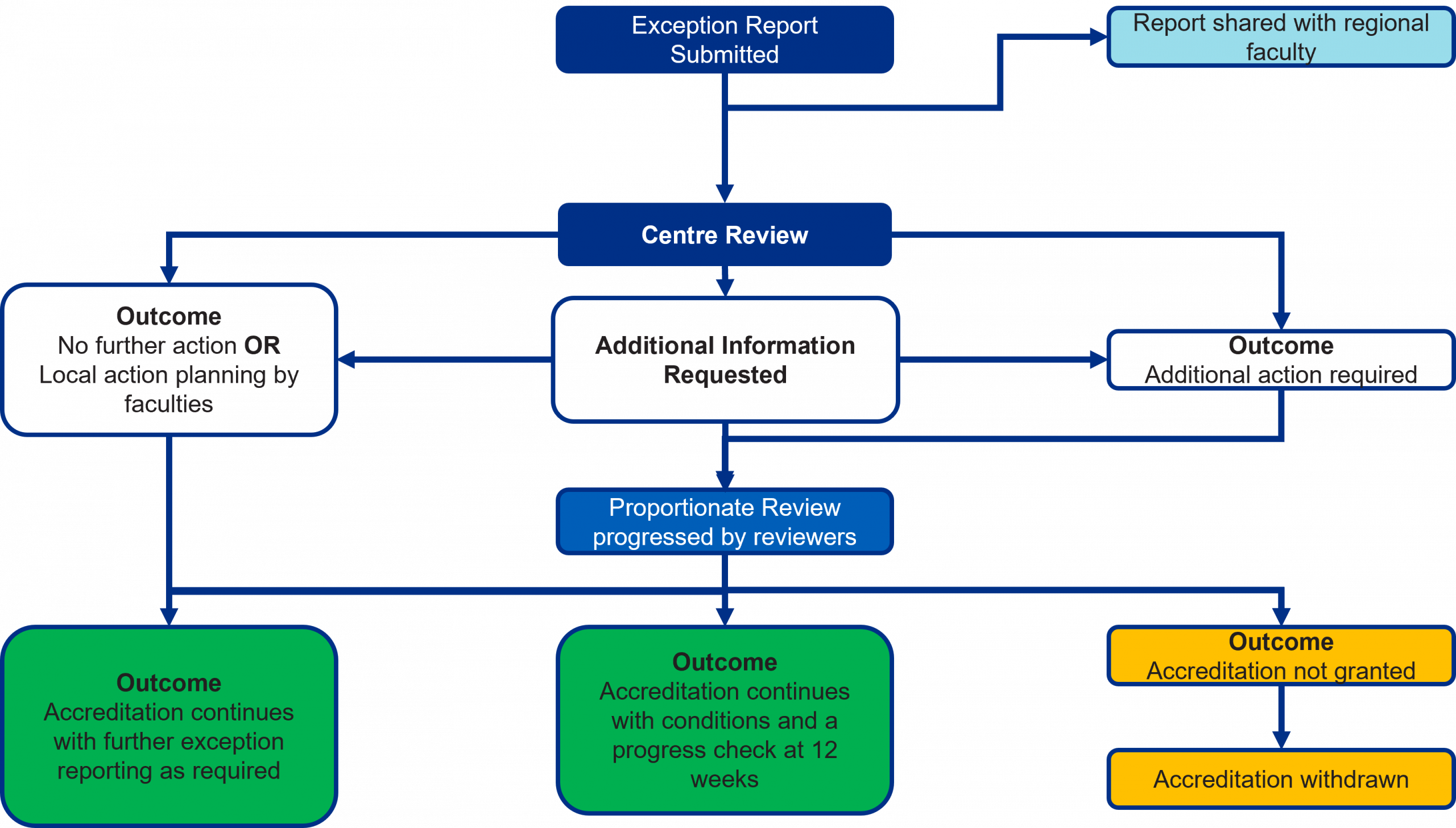
Figure 1 below describes an Education Provider’s routes through the exception reporting processes and the potential outcomes.
The Centre’s approach to Exception Reporting is:
Responsive
A proportionate action can be triggered during the accreditation monitoring phase and at any time, in response to an exception report or concern
Right Touch
The approach is flexible to respond to the nature or impact of programme changes or quality concerns.
Proportionate
Actions taken to address any mapping or quality concerns are proportionate to the level of assurance provided by the education provider that programme changes are managed well and do not adversely impact on the programme’s quality or continued ability to map against the MPF and/or SET.
Completing an Exception Report
Exception reporting is the responsibility of the education provider. When a programme has moved to the exception reporting phase, after the first year of annual monitoring has been successfully completed, an exception report is expected when quality concerns emerge and/or changes are made. The Centre ideally requires exceptions to be reported ‘in real time,’ wherever possible.
Faculties can also submit an exception report should concerns arise.
If an education provider or their regional faculty for advancing practice is not clear whether a programme change or quality issue constitutes an exception, they can contact the Centre for further advice.
When reviewing the exception report, the Centre will also take into consideration any other exception report submissions that may have led to incremental changes to help determine whether further action is needed.
Where no further action is needed, the programme will retain its accreditation and continue with further Exception Reporting as and when required.
Where further action is needed, additional information may be requested, and a proportionate review may be instigated and undertaken by Centre reviewers. The education provider may be asked, dependent on the extent of the programme changes or quality concerns being reported, to:
- provide additional information
- undertake partial re-mapping or
- undertake full re-mapping
In these circumstances, accreditation would continue, pending the outcome of the review. The outcome of the review could be:
- Accreditation continues and programme continues with exception reporting
- Accreditation continues subject to conditions – A 12-week check is undertaken and if satisfactory the programme continues with exception reporting
- Accreditation is not granted and is withdrawn
In these circumstances, accreditation would continue, pending the outcome of the review. The outcome of the review could be:
- accreditation continues with further exception reporting as required
- accreditation continues subject to conditions – a 12-week check is undertaken and if satisfactory, the programme continues with exception reporting
- accreditation is not granted and is withdrawn
The complaints and appeal policy is available.
Examples of Exceptions
Figure 2 below provides examples of exceptions that can be included in an exception report. However, any change or quality concern that has the potential to impact on the programme’s continued ability to map against the MPF and/or SET or affect digital badge eligibility checking should be reported.
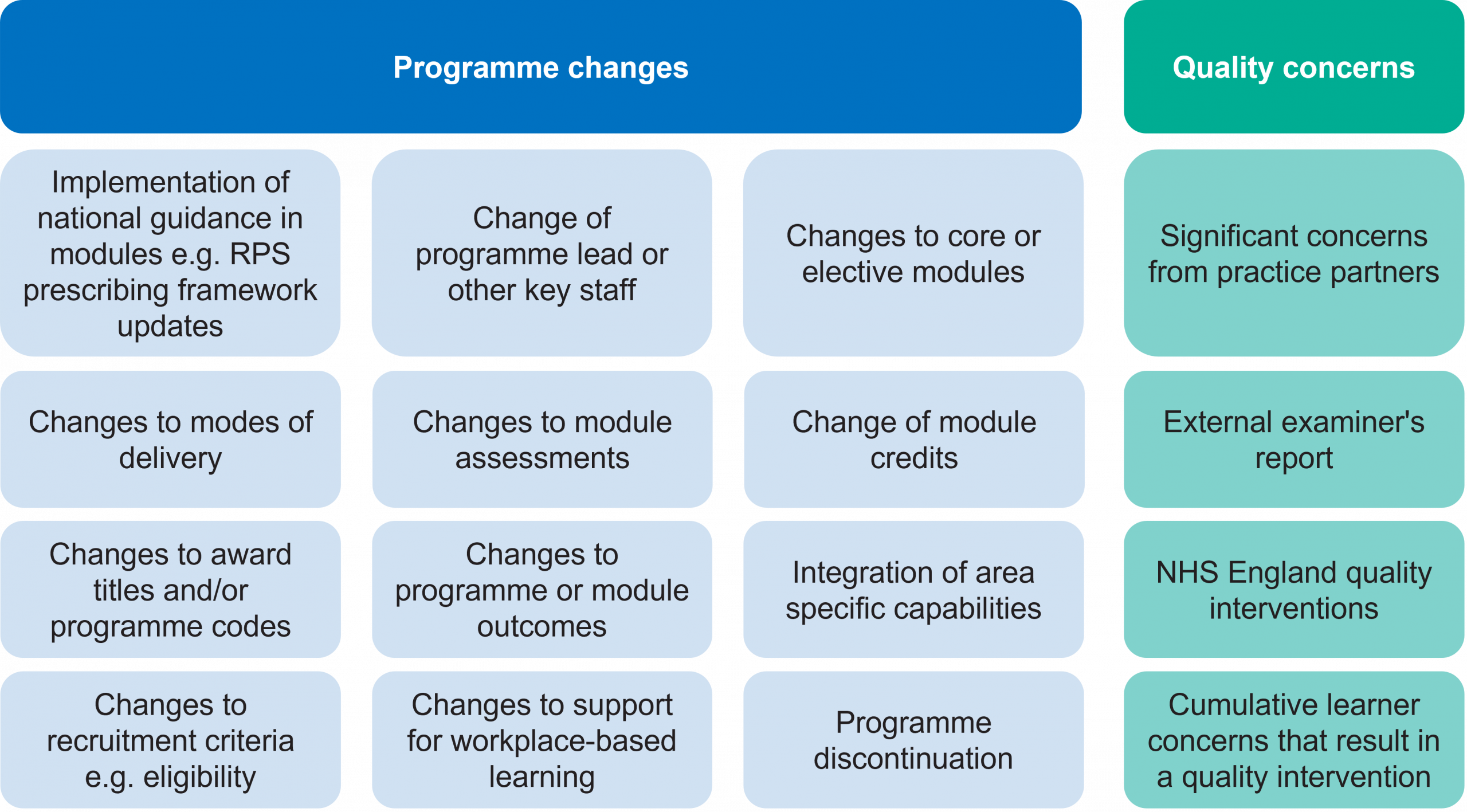
For programme changes, Education Providers need to:
- Describe the nature of the change
- Describe the rationale for the change
- Describe the impact on mapping to the MPF and/or SET
- Outline any actions taken to minimise the impact of the change on the programme’s continued ability to map against the MPF and/or SET (where relevant)
Integrating area specific capabilities in accredited programmes
Area specific capabilities and curriculum frameworks can be integrated into accredited programmes either as core modules or option modules within an existing programme. It is anticipated that area specific capabilities will often be delivered within the variable range of 15-60 level 7 credits within existing MSc advanced practice programmes.
Changes that might be made to a programme may relate to the inclusion of area specific capabilities or frameworks into an existing programme. Particular guidance is offered in this instance in the Centre’s guidance on integration of area specific capabilities.
Quality concerns
Where quality concerns are being reported, education providers are asked to:
- Describe the quality issue
- Describe the impact on mapping to the MPF and/or SET
- Outline any actions and/or mitigations that have been put in place to address the concern.
- Ensure the involvement of the respective regional faculty for advancing practice prior to any exception reporting, and to provide details of those liaisons
Supporting Information
The relevant supporting information to submit will be dependent upon the change or quality concern being reported. Some examples could be:
- Programme staff CVs
- Programme and/or Module Specifications
- Programme and/or Module Assessment Strategies
- Mapping documents
- Annual Programme Evaluations
- External Examiners reports
- Action Plans from other relevant external reviews
- Evidence of engagement with stakeholders e.g., employers, learners, patients & carers
Supporting information can be uploaded to the programme’s SharePoint folder.
The Centre’s approach to assessing changes to accredited programmes (including the integration of area specific capabilities)
On receipt of a completed exception report, the Centre will give initial threshold assessment consideration as to whether further scrutiny via a proportionate review is required, in some cases this may be after further information/clarification has been sought. A summary of the recommended threshold approach to be taken by the Centre when assessing submitted exception reports is presented in ‘Table 1: Summary of suggested responses to programme changes’. The recommended approach facilitates consistent initial decision-making by the Centre in determining the threshold for the extent of proportionate review required for the reassessment of programmes against accreditation mapping criteria.
Threshold assessment options
- Option A: If the integration of an area specific capability is implemented via option modules within an existing accredited programme – without changes to core modules or the programme title – then the exception report is usually accepted, with or without a request for additional information. Any proposed change to the programme title in order to reflect a speciality pathway, even if only option modules are used, will require Option B or C depending on the extent of the change.
- Option B: If the integration of an area specific capability is implemented via either: a modification to one or more existing core modules, or replacement of one or more core modules, with up to a maximum of 60 credits modified and/or replaced; then the exception report will normally initiate a request for additional information, which may then lead to a proportionate review, which could include partial re-mapping of the programme.
- Option C: if the integration of an area specific capability is implemented via either: a modification to one or more core modules, or replacement of one or more core modules with a new module, with more than 60 credits modified or replaced, then the exception report will normally initiate an additional information request and proportionate review for either a partial or full re-mapping by reviewers.
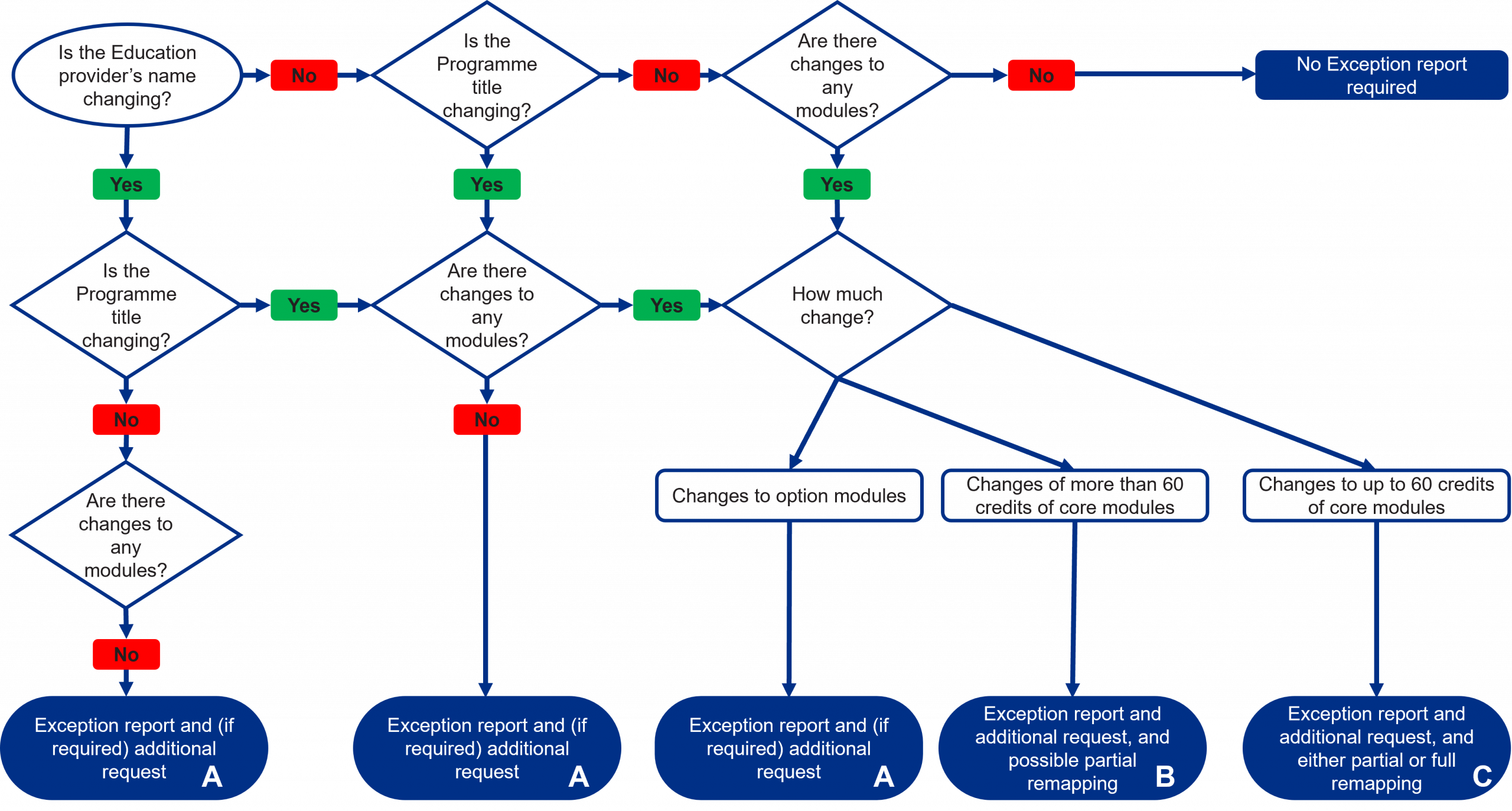
Table 1: Summary of suggested responses to programme changes
| Threshold assessment options | Module changes | AND | Programme title | Suggested review response |
|---|---|---|---|---|
| A | Changes to option modules only | AND | No title change | Exception report and (if required) additional information request |
| B | Changes to up to 60 credits of core modules | AND | Either changing or not changing title with modifications up to 60 credits of core modules (OR using option modules for a title change) | Exception report and additional information request, and possible partial re-mapping |
| C | Changes to more than 60 credits of core modules | AND | Either changing or not changing title with modifications to more than 60 credits | Exception report and additional information request, and either partial or full re-mapping |
Exception Reporting Process
The flowchart below provides an overview of the exception reporting process and timescales.
| Stage 1 | Timeline | |
|
Exception Report Submission |
|
As required |
|
Faculty for Advancing Practice Review |
|
Within 2 Weeks |

| Stage 2 | Timeline | |
|
Centre for Advancing Practice Review |
The Centre reviews the submission
In this circumstance, accreditation continues, pending the outcome of the review.
|
6-12 weeks (depending on actions required) |
| Stage 3 | Timeline | |
|
Centre Governance |
|
Next Meeting |
|
Outcome Notification |
|
|
|
Next Steps |
|
|
Roles and Responsibilities
An overview of the roles and responsibilities for the Centre, Regional Faculties for Advancing Practice and Education Providers in relation to Exception Reporting.
Centre for Advancing Practice
- Maintain and update a central log of accredited programmes
- Maintain oversight of the quality of accredited advanced practice programmes
- Communicate with the Education Provider’s and Regional Faculty for Advancing Practice regarding quality concerns
- Communicate quality concerns into wider quality processes
- Receive and review Exception Reports
- Take proportionate action where substantial changes or quality concerns emerge
- Co-ordinate with the reviewers undertaking the proportionate reviews
- Utilise the Independent Panel where appropriate
- Report outcomes to the Education Assurance Group
- Notify Education Providers of their outcomes
Regional Faculty for Advancing Practice
- Engage with the Education Providers and reiterate their responsibility to report exceptions
- Review the Education Providers Exception Reports
- Provide input and feedback on Exception Reports, offering key information that links to the triangulation of data and regional intelligence that supports or raises concerns with regards to the accredited programme
- Work with other Faculties where relevant
- Discuss reports with Education Providers where necessary
- Work with Regional Quality teams and the Centre to identify and manage quality concerns
- Notify the Centre of quality concerns that have been escalated to Regional Quality Teams
- Submit an Exception Report to the Centre where quality concerns emerge
- Instigate Local Action Planning if necessary where minor quality concerns emerge that do not impact on mapping against the MPF and/or SET
Education Provider
- Actively engage with the Centre and Faculties in relation to their accredited programmes
- Submit an Exception Report to the Centre at the point where programme changes are made or quality concerns emerge
- Participate fully in proportionate reviews instigated by the Centre
- Engage with Faculties in their wider monitoring role and to address any minor quality concerns that do not impact on the programmes continued ability to map against the MPF and/or SET
- Communicate changes in programme accreditation status to learners and stakeholders in a timely manner
Appendix One – Exception Report
Downloads
The Centre for Advancing Practice
Exception Reporting: Guidance for Education Providers

Exception Reporting – Editable for download