This guide explains how to submit an ePortfolio for recognition via the supported route. It covers the steps for applicants, the roles of supervisors and reviewers, the verification and moderation process, timescales, outcomes, and what to do if you need to resubmit or appeal.
1. Steps for Applicants
Before submitting your ePortfolio, ensure you have:
- Uploaded all essential evidence to the evidence dashboard, linking each item to at least one capability.
- Had all evidence peer reviewed (via the portal or by a recognised organisation).
- Completed all sections in the application tab: introduction, four pillars, conclusion, references, and evidence list.
- Linked a completed Checklist, signed off by your educational supervisor.
- Completed the Declaration section.
Once these steps are complete, you can submit your ePortfolio to your educational supervisor.
2. Role of the Educational Supervisor
The educational supervisor will:
- Check that all requirements are met, including:
- The Checklist is complete and evidence links are correct.
- File naming conventions are followed.
- The critical narrative includes citations, references, and evidence links.
- Evidence is high quality and covers all required capabilities.
- The narrative demonstrates Master’s level (level 7) learning and writing.
- Confirm that more than one peer reviewer has been used. If only one reviewer is involved, the Centre Team must be notified for additional quality checks.
- Address any conflicts of interest raised by peer reviewers.
- Complete the Submission Form on the Portal.
3. Internal Verification by the Education Provider
After supervisor review, the ePortfolio is submitted for verification by an education reviewer (usually another supervisor not previously involved). Once submitted, the ePortfolio cannot be edited.
Role of the education reviewer
The education reviewer at the education provider will consider the whole ePortfolio. They will make judgement about whether the final submission demonstrates adequate evidence that meet all the capabilities across the four pillars, via the Portal.
They review and make a judgement on whether:
- the full ePortfolio demonstrates fulfilment of the Multi-Professional Framework for Advanced Practice (2025) (‘the Framework’) capabilities across all pillars
- the ePortfolio includes all the essential evidence as set out in the evidence section in the Route Guide. Also, that each piece has been confirmed as current and authentic, either by another organisation such as a university or professional body, or by a professional colleague, who meets peer reviewer criteria
- the critical narrative and supporting evidence shows enough depth, breadth, synthesis and integration of learning and development to show fulfilment of the capabilities within the scope of practice and Advanced Practice role
- the critical narrative demonstrates the characteristics of level 7 (Master’s level) learning and writing (see the critical narrative section of the Route Guide)
- that the following requirements have been met:
- the published file naming convention has been used when a piece of evidence has been uploaded onto the portal
- the critical narrative includes citations, a reference list, and a list of evidence referred to in the text, with portal evidence links
- the Checklist has been completed correctly
- the Declaration section has been completed correctly
- the applicant has included a range of and high-quality supporting evidence (recognising that a single piece of evidence can be linked to more than one capability and across the pillars)
- the ePortfolio includes enough evidence that capability has been assessed by an appropriate healthcare professional to show fulfilment of the Framework’ (2025) capabilities
- the evidence ensures the anonymity and confidentially of others (including patients, carers, colleagues and students) and complies with General Data Protection Regulation (GDPR) requirements
- that any conflicts of interest that have not been resolved with the educational supervisor are recorded. The education reviewer should note any conflicts of interests on the verification form, recording which have been resolved and which have not been resolved (see also Evidence section of the Route Guide).
4. Verification Process
The education reviewer considers the full portfolio submission and completes the Education Reviewer form on the Portal. They should record comments for the following questions:
- has all essential evidence been submitted?
- does the critical narrative demonstrate sufficiently the characteristics of level 7 (Masters level) learning and writing?
- does the critical narrative demonstrate sufficiently the characteristics of, and working at, advanced practice level (Multi-professional Framework, 2025)?
- overall, has the applicant has evidenced that they meet all the capabilities within each pillar within the Framework (2025)
- can recognition of education, training and experience equivalence be awarded
If recognition cannot be awarded, the education reviewer needs to identify the deficiencies and provide feedback regarding any actions to be taken.
5. Moderation by the Education Provider
Internal moderation is a practice used to ensure fairness and consistency. To “moderate” means to adjust or regulate according to certain standards or rules. When it comes to checking an ePortfolio application, internal moderation is important. It makes sure that the verification process is done correctly and that decisions are fair to all applicants.
Through the moderation process the education provider is checking:
- agreement across the educational supervisors’/education reviewers’ judgements.
- whether the verification decision and the original portfolio demonstrates achievement of the capabilities.
- That suitable feedback has been provided where the capabilities or the ePortfolio requirements have not been met
Education providers should undertake a moderation process which is in keeping with their university guidance.
6. Timescales
Submission deadline
All applicants must submit their ePortfolio within 12 months after their final LNA meeting, unless mitigating circumstances are in place. The submission date can be found on the Portal.
If an applicant misses this deadline without an extension in place, their ePortfolio application will be “timed-out” on the Portal. This means their ePortfolio will be marked as “incomplete,” and they will not be able to submit it or edit it.
The final deadline shown on the Portal is the last day to submit the ePortfolio for the first time. Any submissions to the educational supervisor and any changes made must be done before this final deadline.
If an applicant has to resubmit their ePortfolio (see Resubmission section below), it will be reopened and the deadline date reset.
If an applicant has mitigating circumstances that might qualify for an extension, they should talk to their educational supervisor about it (see mitigating circumstances section of the Route Guide). Applicants must submit their requests for these circumstances through the Portal, and the educational supervisor must approve them. Once approved, the education provider will update the submission deadline on the Portal.
The maximum amount of time an applicant can be registered on the ePortfolio (supported) Route is 24 months and only with appropriate mitigating circumstances agreed by the education provider.
Assessment timeframe
An education provider is expected to complete the review and verification process within four weeks of submission. Including the internal quality assurance process at the education provider.
7. Outcomes
There are two possible outcomes for submitted ePortfolios:
Non-urgent advice: Outcome 1
The capabilities across all four pillars have been fully met, with the applicant’s recognition of education and training equivalence that aligns to the Multi-Professional Framework for Advanced Practice (2025) confirmed.
Non-urgent advice: Outcome 2
Further evidence is required.
If the education reviewer selects an outcome 2 at this stage, they must provide feedback, outlining areas of deficiency and give an indication of any action to be taken.
An outcome 2 may be considered where an applicant has not met one or more pillar or where there is weakness in meeting the capabilities across all four pillars.
Once the education provider has completed the verification process, the ePortfolio will enter the Centre’s Quality and Standardisation process. This applies to outcome 1 and outcome 2 ePortfolios
8. Factors That May Halt Consideration
If there is a suspicion that one or more of the following has occurred, then the educational supervisor will discuss this with the applicant, record the details and discuss the situation with the education provider ePortfolio (supported) Route team.
The ePortfolio:
- raises potential issues of unsafe or unethical practice
- includes patient identifiers
- plagiarises others’ work, including the inappropriate usage of and not attributing the use of generative artificial intelligence
- does not give due acknowledgement to others’ contributions
- seeks to pass off others’ work as the applicant’s own
The education provider will then consider the best action to take which might include:
- asking the applicant to undertake specific actions
- informing the relevant statutory regulator
- informing the applicant’s employer
- rejecting the application
9. Resubmissions
Resubmissions occur where an applicant is requested to provide some additional evidence or clarification.
Applicants will have one opportunity to amend and resubmit their ePortfolio to address the feedback provided. The resubmitted ePortfolio will be considered by the education reviewer to confirm if the feedback has been completed and go through the Centre’s Quality and Standardisation process.
Normally, if after the resubmission, an outcome 1 is not awarded by the education reviewer, the ePortfolio will not be progressed any further, unless there are mitigating circumstances agreed by the education provider and Centre.
If an applicant has to resubmit their ePortfolio, it will be reopened and a new deadline set.
Adding new evidence: If an applicant needs to submit new or revised evidence they should:
- make it clear that it is a new piece of evidence by including the term ‘new’ or ‘revised’ in the evidence file name
- link the new piece of evidence to at least one capability
- archive the old piece of evidence (see ‘How to Guide: Evidence)
- create a new Checklist adding a new link to the evidence and add a link in the relevant section of the application tab
- update the list of evidence at the end of the critical narrative
10. Centre’s Quality and Standardisation Process
The purpose of the Centre’s Quality and Standardisation process is to ensure the integrity of the Route and stakeholder confidence in the process and outcomes by assuring that:
- all requirements set out in the Route Guide have been met to allow a digital badge to be awarded
- education providers are assessing against the same threshold standards to ensure that there is comparative consistency across education providers in the assessment process and the feedback provided to applicants, where appropriate. The threshold standards is that an applicant demonstrates mapping equivalence to all capabilities of the Framework (2025), and the essential requirements and components of the ePortfolio as detailed in the Checklist.
The Centre’s Quality and Standardisation process has a two-stage approach:
- Firstly, ‘Stage 1’ is an ‘initial review’ by the Centre’s Quality and Standardisation Panel of all ePortfolios submitted by an education provider, until four ‘outcome 1’ ePortfolios are considered to meet the appropriate standards. The purpose of this review is to provide an early check that threshold standards are being applied, and due process is being followed.
- Once an education provider has demonstrated that all outcome 1 meet the requirements. They move into ‘Stage 2’ where a ‘sampling’ approach is taken and panel to reviews a sample of ePortfolios for quality and standardisation purposes, ensuring that education providers are continuing to apply threshold standards and are following due process.
Note, all ePortfolio receiving an ‘outcome 2-further evidence required are reviewed by a Quality and Standardisation panel.
Any ePortfolios returned to the education provider during the Quality and Standardisation process have the opportunity to be resubmitted. Timeframes for resubmission are determined by the education provider. All resubmissions will be listed for the next available panel, to limit time delays. Panels usually sit monthly.
The ePortfolio (supported) Route team aims to complete the Quality and Standardisation process within 12 weeks. The Centre’s 12 week ‘clock’ commences at the point the verification form has been submitted by the educational reviewer.
11. Notification of Outcome
Applicants will be notified of their outcome via the Portal, following completion of the Quality and Standardisation process. The outcome will be available via the ‘outcome’ tab on the applicant’s Portal dashboard.
Where additional feedback has been provided by the Quality and Standardisation panel, this will be shared with the education provider. The educational supervisor will discuss the feedback from the panel and the education reviewer with the applicant.
Where the educational supervisor has selected an ‘outcome 2-further evidence required’, the feedback for the applicant will be added to the ‘outcome’ section of the Portal by the ePortfolio Team.
If a digital badge has been awarded, guidance on how to download a digital badges is available via the NHS England Learning Hub.
12. Governance and sign off
All outcomes are presented to the Centre’s Education Assurance Group (EAG) on a bi-monthly basis for information and ratification of the Quality and Standardisation panel outcomes.
13. Appeals and complaints process
The Centre has procedures for appeals and complaints raised in relation to the Centre for Advancing Practice’s (‘the Centre’s’) recognition processes, including the ePortfolio (supported) Route.
An appeal is a request for the re-consideration of a decision regarding the outcome of a recognition process (see below) based on the reasonable belief that a procedural irregularity or administrative error has occurred.
An individual cannot appeal to challenge the judgement of the reviewers or the Centre’s Education Assurance Group who ratifies the outcomes. The fact that an individual believes that they deserve a different outcome cannot constitute grounds for appeal.
An appeal must be made within 10 working days of receipt of the outcome of the application. It must be made in writing and addressed to the Lead for the Centre for Advancing Practice. An appeal should be emailed via england.advancedpractice@nhs.net
A complaint is any expression of dissatisfaction about the standard of services provided in relation to the Centre’s recognition processes. The Centre recognises that, on occasion, there may be legitimate complaints which individuals will wish to raise.
by step portal guidance

The NHS Learning Hub hosts the Centre for Advancing Practice Portal guidance.
You will need an account at access. If you do not have an account, you can create one. When creating an account you will need to enter basic information on your role and place of work.
Centre for Advancing Practice Portal
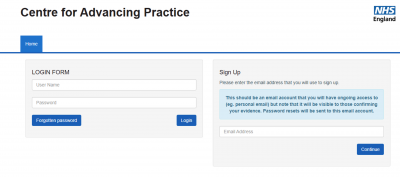
The Centre for Advancing Practice Portal is a web-based tool that enables practitioners to record evidence of their experience, training and continuing professional development (CPD) for their entire career.