Trailblazers
How Advanced Practice Is Re‑shaping Community MSK Care
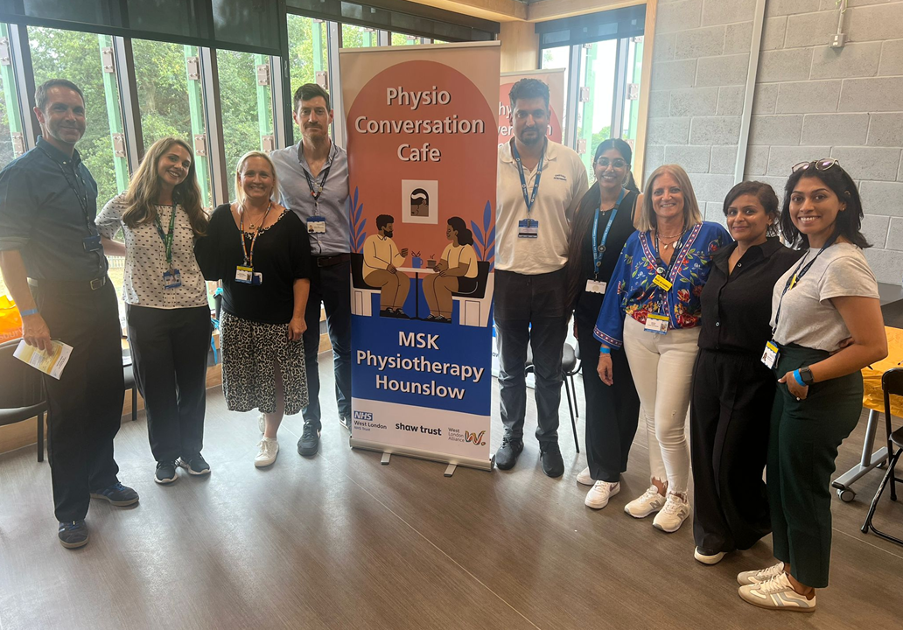
Names: ( left to right): Richard Lil, Phoebe Cassedy, Becky Lydon, Simon Shaw, Sumeer Bhamm, Amanpreet Atwal, Nati Arnaldos, Reena Patel, Taneesha Dhillon
For years, the story of community MSK services has been a familiar one: long waiting lists, fragmented support, and patients moving slowly through a system that only starts to help once their problem has already taken hold. For many, especially those facing wider social and economic challenges, musculoskeletal pain is never just about joints or backs, it is about work, housing, confidence, finances, and the slow erosion of independence.
The Trailblazer programme itself is a six‑month support programme for Physiotherapists and Health Coaches, delivered in partnership with the Department for Work and Pensions (DWP). Participation in this programme provided access to established stakeholder networks, dedicated support and funding, which advanced practitioners were then able to leverage to design and implement the Community Assessment Days as an extension of the opportunity, rather than as part of the original Trailblazer model.
In Northwest London, a group of advanced practitioners decided to challenge that model.
What emerged was not a new clinic, nor a tweak to referral criteria, but a fundamentally different way of thinking about care: a community assessment day, built around partnership (DWP), prevention, and trust. Known locally as the Trailblazer MSK Programme, the initiative brings healthcare, employment, and community support together in one place and it is already changing outcomes for patients and the system alike.
Ajay Bhatt sits down with Becky Lydon Advanced Practice Physiotherapist and Advance Practice lead for West London Trust and NWL Trailblazer to find out about this novel way of approaching community health care.
A different starting point
Instead of waiting up to 18 weeks for a traditional one to‑ one physiotherapy appointment, patients are invited to attend a community assessment day early in their journey. These are not clinical production lines. They are deliberately designed as open, accessible, “‑caféstyle‑” environments hosted in community venues such as sports centres.
On the day, patients can speak with advanced physiotherapists, but they can also access a wide range of partners who would traditionally sit far outside a healthcare pathway: social prescribers, council services, talking therapies, employment advisors, Citizens Advice, health and wellbeing coaches, and community exercise providers.
This matters because MSK pain rarely exists in isolation. Many people attending these events are dealing with low income, unstable housing, unemployment, or the fear of losing work. Previously, they would have had to wait for a clinical appointment before being signposted to other services. Here, the doors are opened immediately.
As one advanced physiotherapist involved in the programme describes it: “Patients might come in with back pain, but what’s really driving their distress is the fear of losing their job, or not being able to afford the gym, or feeling isolated. We can address all of that in one place, on one day.”
Advanced practice in action — beyond the clinic
What makes this model possible is advanced practice, not simply as a clinical role but as a leadership and systems shaping‑ function.
Advanced physiotherapists within the service retain high level‑ clinical autonomy: diagnosing, triaging, organising investigations, and preventing unnecessary referrals into secondary care. But crucially, their roles are also designed with protected time for leadership, governance, and service redesign.
That space often absent from traditional roles allowed advanced practitioners to step back and ask different questions. Where are the bottlenecks? Why are patients waiting? What support exists in the community that we only access too late? How could the patient journey be redesigned rather than simply sped up?
The Trailblazer programme is the answer to those questions.
It is also a powerful reminder that advanced practice is not about “doing more medicine”. It is about integrating clinical expertise with system thinking, workforce redesign, and partnership working drawing equally on all four pillars of advanced practice.
MDT working without walls
Multidisciplinary working is often talked about but rarely lived in this way. The Trailblazer model dissolves professional boundaries by design. Health, employment, and community partners do not work in parallel; they work side by side.
Physiotherapists communicate directly with health and employment coaches. Patients who are appropriate can be enrolled into a six-month‑ employment support programme that runs alongside MSK rehabilitation, offering financial support, psychological input, and personalised goal‑setting to help people return to work safely and sustainably.
This partnership with the Department for Work and Pensions required courage, persistence, and careful governance. Data sharing, information governance, and role clarity all had to be navigated thoughtfully. But the result is a model that tackles one of the biggest drivers of MSK demand worklessness without medicalising it.
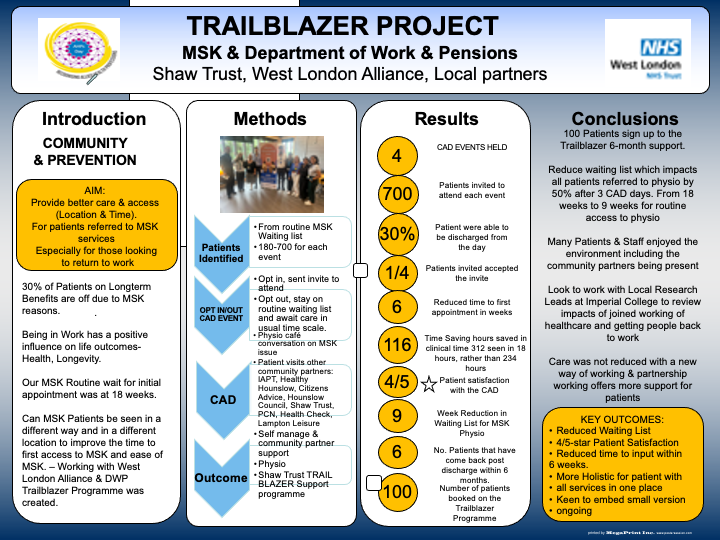
The impact has been striking.
Each community assessment day reduces the MSK waiting list by around three weeks. Over time, waiting times have fallen from 18 weeks to approximately eight weeks. Early access means fewer patients becoming chronic and more people managing their conditions independently.
Around 35% of patients choose to self-manage after attending the event, supported through patient-initiated ‑follow-up rather than sitting invisibly on a waiting list. ‑Six-month‑ data shows that only nine patients from this group needed to return, which represents an extraordinarily low re‑contact rate.
For those enrolled in the Trailblazer employment programme, the outcomes are equally powerful. Of participants suitable for work focused‑ support, over a third have already returned to employment, with others progressing towards work or gaining confidence and stability for the first time in years. Many had been unemployed for more than three years; some had never worked at all.
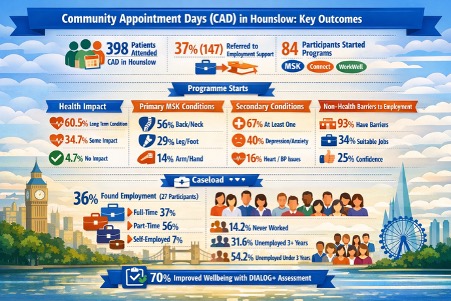
This is not just MSK care. It is population health in action.
Staff experience and professional growth
Initially, staff were apprehensive. Inviting hundreds of patients to a single event felt risky. But the experience transformed expectations.
Physiotherapists reported seeing more patients in a shorter period than traditional clinics, without sacrificing quality. Freed from repetitive assessments, they focused on listening, problem solving‑, and understanding what truly mattered to patients.
Advanced practitioners, in particular, found their skills uniquely suited to this environment. The work relied less on hands-on‑ testing and more on clinical reasoning, communication, and social awareness – precisely the strengths developed through advanced practice.
As one clinician reflected: “Within five minutes, you often understand what’s really going on. Once you address that, the MSK problem becomes manageable.”
Governance, safety, and trust
Innovation does not mean abandoning rigour. Governance was built into the model from the outset. Clear escalation plans were in place for unexpected clinical findings. Documentation processes ensured patients were not lost to follow-up‑. Feedback and outcome data were systematically collected.
The result is a service that feels bold but remains safe, accountable, and trusted by patients, partners, and staff.
Looking ahead: from pilot to practice
The programme has now been recommissioned and rolled out across all 18 PCNs, but its ambition goes further. The long-term‑ vision is not to replace clinics, but to embed community based‑, preventative models into routine care reaching people earlier, in places they already are.
Future iterations may focus on specific populations such as osteoarthritis or target community events proactively rather than relying on waiting lists at all. Crucially, advanced practitioners will continue to be the catalysts spotting opportunities, designing solutions, and connecting systems.
Why this matters now
At a time when the NHS faces unprecedented pressure, the Trailblazer MSK Programme offers a compelling lesson. Efficiency does not come from doing the same things faster. It comes from doing different things earlier.
Advanced practitioners are uniquely placed to lead that shift. They are not substitutes for doctors, nor extensions of traditional roles. They are pragmatic, system aware ‑problem solvers‑ who can bridge clinical care, community support, and strategic thinking.
If we are serious about prevention, integration, and sustainability, then advanced practice should not sit at the margins of innovation. It should be at the table shaping it. The Trailblazer programme shows what becomes possible when that happens.
Editorial and Interviews by: Ajay Bhatt – NHSE – Advancing Practice Faculty – London